Category
Essays
-
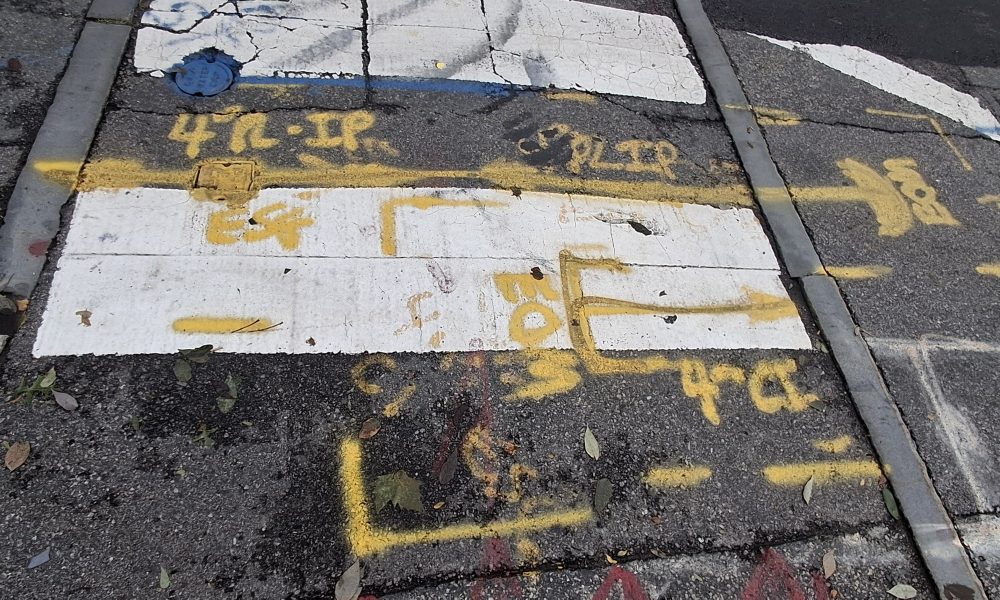
Law, Written in Spray Paint
“Paying attention to the temporary markings etched onto the asphalt, we are afforded a glimpse into the otherwise hidden world that lies below the city’s surface.”



-
Welcome to the Public Books Blog
Since we began Public Books in June 2012, we’ve often found ourselves wanting to publish pieces that, for reasons of length, timeliness, or subject matter, fall outside the scope of our biweekly book reviews. In our new blog, we’re looking forward to bringing you news and updates from our contributors, short reviews of what’s happening…
-

Changes
The first thing that happens, when a literary historian starts using computers to think about literature, is that the object of study changes. Not just the tool; the object itself. “The objects studied by contemporary historians” have this peculiarity, Krzysztof Pomian observed some time ago, that “no one has ever seen them, and no one…
-
The Restless Storyteller: An Interview With Laura Bolaños Cadena
Historia Semanal de Amor y Pasión (Weekly Story of Love and Passion) is one of those pocket-size Mexican comic books you may have read or seen—they’re called historietas. The covers are illustrated in eye-popping colors, and the drama inside is high and often fast. One of the most twisty and gripping issues I’ve read contained…
-

Translation: Oneself As Another
As part of our co-sponsorship of Villa Gillet’s Walls and Bridges festival, we are pleased to publish the following brief declaration of principles by the French writer and translator Frédéric Boyer. On Friday, October 18, Boyer will deliver a keynote address at the mini-conference “Found in Translation,” an event celebrating the publication of In Translation: Translators on…
-

Hari Kunzru on Networks, the Novel, and the Politics of the Author
Hari Kunzru is a British-born writer who lives and works in New York. He is the author of four novels as well as numerous articles in publications including Wired, the New Yorker, the Washington Post, the Times of India, and the New Statesman. His first novel, The Impressionist (2002), which won the Betty Trask Prize,…
-
Alexis Rockman: Drawings from Life of Pi; with A Letter to the Artist
Public Books is pleased to present our first collaboration with the Lyon-based cultural institute Villa Gillet in connection with their fall Walls and Bridges festival in New York City. From October 9 to 20 the festival will celebrate critical inquiry and performance by French and American thinkers and artists from across the humanities, social sciences, and arts. Public Books is…
-

Reflecting Absence: An Interview with Michael Arad
Michael Arad’s winning design for the World Trade Center Memorial has created a landmark for New York City and for design. “Reflecting Absence,” the theme and title of Arad’s winning entry, raises questions about loss and memory, but also about bringing life to city streets. In conversation with Harel Shapira, Arad discusses the democratic uses…
-
RiteCheck 12
The sky is inky black when my alarm clock gongs at 5:30 a.m. By the time I’ve showered and left the house, it’s 6:20, and I hunch my shoulders against January’s cold, hurrying the two blocks from my still quiet house in Park Slope to the 7th Avenue F train stop. The bright light of…
-
Close Out
In 2008, through research on the work in his Copia series, Brian Ulrich began collecting, salvaging, and archiving objects, photographs, signage, and ephemera from the remnants of the retail spaces he had been photographing. Many of these objects evoked specific narratives of American consumer culture from important eras in its economic history. Ulrich liked the…
-

The Confidence Economy: An Interview with T. J. Jackson Lears
Questions about trust, faith, and chance in American cultural history are at the core of your work as I see it. Your interest in confidence and con men is especially striking …
-
The Whole World Blind
To experience the full effect of the installation please use a blindfold, or at the very least close your eyes and do not open them until you are done listening. Listen in a gallery-like space or library (where you will be safe while blindfolded) through an mp3 player or on a computer. And use the…
-

Soldier Exposures and Technical Publics
In this collaborative visual essay, we consider an idiosyncratic assemblage of pictures of American soldiers. These are not iconic images that “speak for themselves” but less conventional ones that suggest both the technical expertise involved in producing and managing war’s violence and the vulnerability of soldiers at the heart of war. In considering these images…
-

Back to Kindergarten! A Modest Proposal for a College of the Future
A visit to that marvelous Century of the Child design show at the Museum of Modern Art in New York last summer set me to musing all over again. Marvelous, I say, albeit a bit of a missed opportunity. And musing, as it happens, not so much about children past as about colleges future. Regarding…
-
Transatlantic Feminism Post–DSK Affair
Autumn 2012 in Paris, la rentrée, and a host of new books dealing with the aftershocks of summer 2011’s biggest political scandal are piled up on bookstore tables. A novel by Stéphane Zagdanski, Chaos brûlant (Burning Chaos), is particularly sensational, featuring the spectacular demise of former International Monetary Fund (IMF) director Dominique Strauss-Kahn as seen…
-
The Island Position
The Island Position is an advertising term used to describe the premium position of an advertisement surrounded solely by editorial content. John Lehr’s series of the same name describes the familiar facades that line the main streets and thoroughfares of America’s cities and towns. These office spaces and storefronts have clearly been around for a while,…
-
Infra
For centuries, the Congo has compelled and defied the Western imagination. Richard Mosse brings to this subject the use of a discontinued military surveillance technology, a type of color infrared film called Kodak Aerochrome. Originally developed for camouflage detection, this aerial reconnaissance film registers an invisible spectrum of infrared light, rendering the green landscape in…
-

Feeling like a Stoic: Doris Lessing’s Experimental Fiction
I came late to Doris Lessing. Although it was back in 1962 that The Golden Notebook established her as the Cassandra of a not-quite-revolutionary generation, I clued …
-

Errol Morris, Forensic Epistemologist
Earlier this year I was contacted by the editors at Zum, a new Brazilian photography quarterly, who explained how they’d lately taken …
-
Recycling Literary Culture: A Conversation with Lúcia Rosa
Over the past decade, a new style of publishing has emerged as a response to the economic and environmental conditions facing twenty-first-century Latin America. Cardboard books, colorfully hand-painted and assembled by workshop collectives, are now bought and sold in nearly every major Latin American city. The “cartonera” publishing collectives take their name from cartoneros: urbanites…