Category
Reviews
-
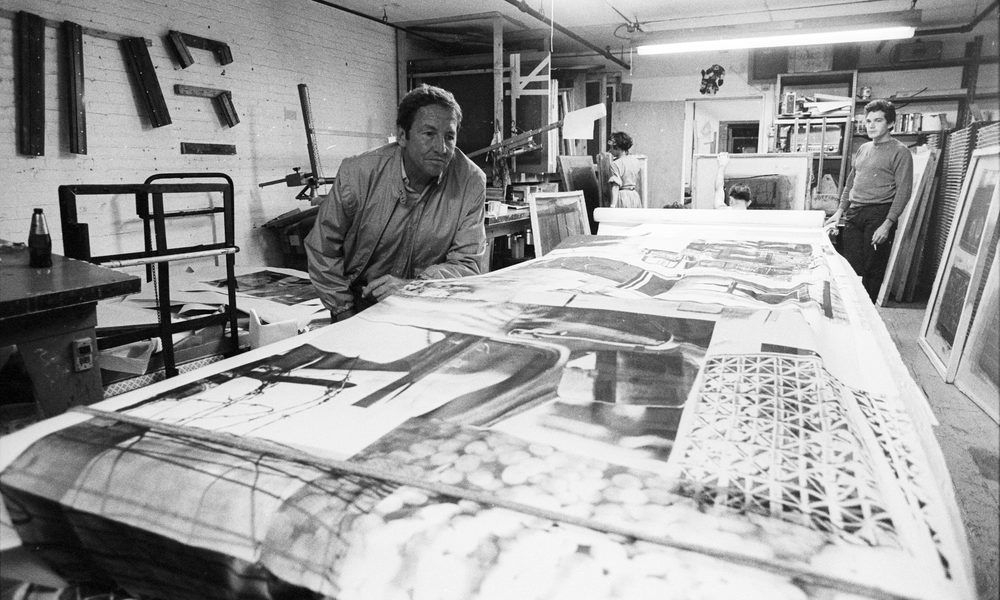
Use and Reuse: Dancing Again with Robert Rauschenberg
“Looking at the Rauschenberg archives was a revelation to me. I’ve never handled a silkscreen, and physics and geometry weren’t my best subjects in high school, but even I could see how ‘Set and Reset’ could be recreated because of the Rauschenberg studio’s meticulous records management.”



-

Fly on the Wall
What is it like to be a fly? What is it like to be a Jew? Despite its trans-species premise—an 18th-century French Jew is reincarnated as a fly in 21st-century Long Island—Jacob’s Folly, the new novel from author and filmmaker Rebecca Miller, is far more interested in answering the latter question than the former. Yes,…
-

It’s Bigger Than “Buck”
Reading M. K. Asante is like flipping pages between generations, going back and forth among the “flowering of Negro literature” of the Harlem Renaissance, the iconoclastic spirit of the Beat generation, and the cornered, misunderstood post-hip-hop generation. Listening to him speak is a similar experience. “My education came from so many different places,” confesses the…
-
A Study in African Realism
We are pleased to accompany Ian Baucom’s review of Americanah with video of Chimamanda Ngozi Adichie in conversation with Professor Baucom and PhD student Ainehi Edoro at a public event hosted by Duke University’s Africa Initiative and Center for African and African American Research earlier this year. As its hybrid title suggests, Chimamanda Adichie’s Americanah, which begins…
-
Unreliable Voices From Europe
The first sentence of the Slovakian writer Balla’s “Before the Breakup,” the opening story in Best European Fiction 2013, goes like this: “Miša discovered there was something in the apartment.” The narrator never describes the something, but it is ominous, attentive, and located behind the television. It is also associated with Miša’s growing unease about…
-

Margaret Mead’s Countercultures
If you were raised in the United States during the 1960s, as I was, and if you came of intellectual age in the 1980s, as I did, chances are that you too have inherited a strangely black-and-white history of mid-20th-century American culture. The story goes something like this: In the wake of World War II,…
-

Michael Pollan’s Dilemma
In the 20th anniversary edition of On Food and Cooking, the celebrated food writer Harold McGee claims that “to understand what’s happening within a food as we cook it, we need to be familiar with the world of invisibly small molecules and their reactions with each other.”1 But why, we might ask? Cooking is cultural as…
-

Don’t Go Back to Princeton
In Joyce Carol Oates’s The Accursed, life in Princeton, NJ, appears as an endless round of frigid isolation, punctuated by the occasional diabolically inventive rape. Circa 1905, a curse has fallen on the well-connected Slades and their milieu, leaving the cream of Princeton beset by vampiric predators, demon lovers, and sex criminals. It has evidently…
-

Dreaming in the Multiverse
The American Southwest has long been associated with unsavory scientific research, from Manhattan Project nuclear experiments at the Los Alamos National Laboratory to the only recently acknowledged Area 51, preferred vacation spot of aliens the universe over. But in American Elsewhere, Robert Jackson Bennett’s latest work of speculative fiction, the little town of Wink, New…
-

The Joys of Multiplicity
Translation contains multitudes. Since there is no one right way to translate most things worth translating—though there are many wrong ways—translation opens up a sphere of multiplicity in which you can elect to enjoy your Bovary à la Lydia Davis or in the style of Steegmuller. Whose Crime and Punishment was Edward Snowden reading in…
-

Latin America’s Left: Between Demos and Kratos
On March 5, 2013, the Venezuelan government announced the death of president Hugo Rafael Chávez Frías. In the New York Review of Books, Alma Guillermoprieto, one of the most perceptive commentators on Latin American politics, wrote that he “mostly left behind a void.” It could not be otherwise, since Chávez “was All.” His loss, for…
-
How Angry Is She?
In April of this year, an interviewer asked Claire Messud a silly question about Nora Eldridge, the complex and prickly protagonist of Messud’s new novel The Woman Upstairs: would Messud want to be friends with her?1 Messud’s exasperated answer—“For heaven’s sake, what kind of question is that?”—was interpreted by some readers as evidence that the…
-
Masters of Reinvention
For the first 40 years of his life, Albert O. Hirschman was a little-known accessory to world-historic events. Born in Berlin in 1915, he was a refugee from Nazi Germany who wound his way through Europe’s anti-fascist movements, US wartime intelligence, the Marshall Plan, a McCarthyist investigation, and the World Bank’s first foray into Third…
-
In Praise of MA (Middle-Aged) Fiction
Reading what we might call MA (Middle-Aged) fiction, it’s easy to see how YA (Young Adult) fiction has become so popular among not-so-young adults. In the face of characters burdened with troublesome children, aging parents, failures of love and marriage, professional frustration (or even more frustrating professional success), depression, cancer, and obesity, who wouldn’t want…
-

The End of the End of the World
Margaret Atwood’s MaddAddam trilogy may be one of the most significant works of 21st-century literature that you haven’t read. Which is surprising, since the novels have been well reviewed, avidly marketed, and abundantly sold. Yet they have been oddly absent from the radar screens of many who consider themselves aficionados of the contemporary novel. This…
-

The History of Secrets
Family Secrets by Deborah Cohen injects the marrow back into two centuries of skeletons locked away in household closets. A leading historian of modern Britain and Europe, Cohen has put together a rollicking read through the hidden land of cultural morality and its fundamental institution, the family. A son who prefers lipstick to lip balm…
-
Giving Birth to a Country
In NoViolet Bulawayo’s shattering debut novel, We Need New Names, proper nouns contain continents. Paradise is the ironically named Zimbabwean shantytown where the book’s ten-year-old protagonist and narrator, Darling, lives with her fractured family and gang of friends, whose names include Bastard and Godknows. Budapest is the rich part of town, where the hungry children…
-

Where Fragile Things Die
In 2005, long before Taiye Selasi was being hailed for her fiction writing as “a totally new and near perfect voice,” she published a brief online essay that sought to define the emerging cohort of young, urbane, culturally hybrid Africans among whom she counted herself.1, “Bye-Bye, Barbar,”The LIP, March 3, 2005. ] Thus was born (or…
-

Déjà Vécu
Kate Atkinson has had an intriguing literary career. After winning popular and critical success with her first novel, Behind the Scenes at the Museum (1995), and a Whitbread Prize, she spent most of the 2000s publishing mystery novels centered on a Scottish private investigator, Jackson Brodie. Even putting the genre distinction aside, it’s hard to…
-

Toads and Bitches
“At last, something beautiful you can truly own,” says Don Draper, pitching to Jaguar executives in the fifth season of Mad Men. This idea of owning a woman is tempered here by metaphor: the car only stands in for the woman. Male ownership of her remains, albeit tenuously, a fantasy. Not so in the case…
-

Story Time
For a few weeks at the start of 2013, George Saunders was the gently puzzled face of American letters. You could see him being interviewed by Stephen Colbert, Charlie Rose, or George Stephanopoulos, talking about empathy and capitalism while demonstrating the Northern Cities Vowel Shift. You could read the New York Times Magazine calling him,…