Being reviewed:
Advertisement

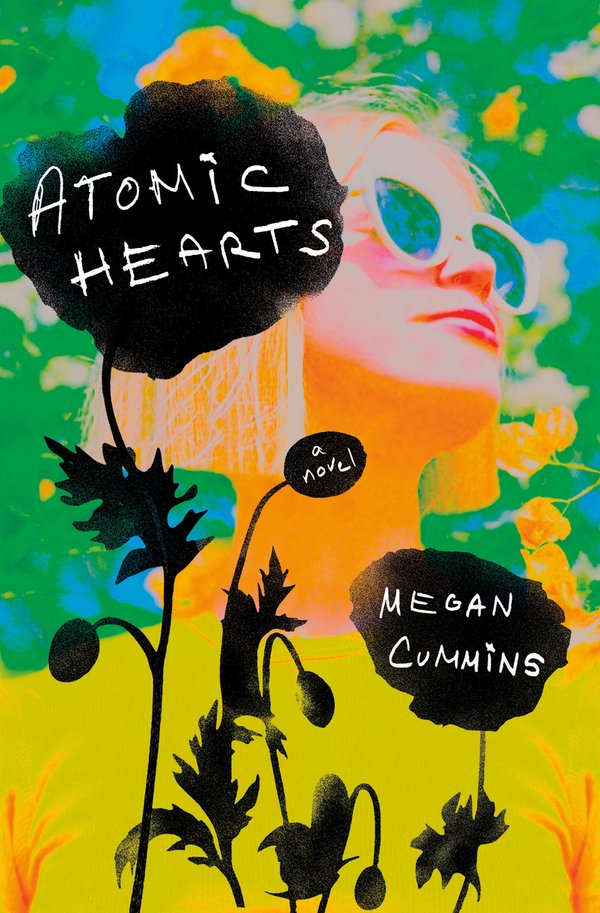
The promise I read into the title of Megan Cummins’s debut novel Atomic Hearts is the potential for a heart to explode, to envelop for miles in all directions a disaster that seems disproportionate to the small locus at the center. There is no sense to the scale of this, but of course this makes perfect sense to anyone who has ever had their heart broken, and also every teenager who has ever existed. The world is always ending when you are 16. It is doubly unfortunate, then, when a 16-year-old is actually faced by the realities of a world-ending struggle like the opioid epidemic, which Atomic Hearts (out today in paperback) explores through the story of a girl and her father.
What I find so impressive about Megan Cummins’s writing is that she can capture the internal feeling of world-ending catastrophe essential to the teenage experience of, for instance, kissing someone you shouldn’t, with the external realities of economic precarities, the male gaze, and substance abuse—all in such a way that those internal struggles feel just as real as the others, and all feed into one another. While we all certainly remember the pain of our teenage years, not as many of us are able to take it as seriously and portray it as beautiful struggles in the way that Cummins can.
To understand this, Megan and I talked about her writing while eating vegan food and drinking brunch cocktails on a rainy weekend afternoon.
Kyle Francis Williams (KFW): You and I talk a lot about place. The stories in your last book, If the Body Allows It, makes portraits of Northern California and Newark that feel very lived in. This book largely takes place in Sioux Falls. What keeps your stories rooted in this way?
Megan Cummins (MC): At a reading last fall, an audience member asked if I considered myself a regional writer. I wanted to say yes but didn’t feel confident enough to make that claim. Was I limited to one region? Can you be a regional writer of all the places you’ve lived—your own personal region made up of places that are, in my case, sort of all over the country? Because I often write about the Midwest, but not always. I’ve written about all the places I’ve lived. I’d never written successfully about a place I haven’t lived, until Atomic Hearts. I’ve spent time in Sioux Falls, but I’ve never lived there. I researched, though, which really means I spent a lot of time on Google Maps. And Yelp, where I wanted to see if a bar in the strip mall where my character goes has outdoor seating or a vinyl Bud Light banner hanging off the railing or if the liquor bottles on the shelves are backlit. (That scene got cut.) Or on the Facebook page of the Pettigrew Home and Museum in Sioux Falls, which is a Queen Anne–style house that belonged to South Dakota’s first US senator. In its kitchen there’s an old Estate gas stove, the kind covered in porcelain enamel, and on its range a cast iron filled with plastic pork chops. (This scene also got cut.) A reader might not miss the pork chops or care if I don’t get an intersection quite right—but I need these details of place to feel grounded, to know or re-know a place as well as my character does in that moment.
Setting is an element of fiction that’s just as layered as plot or character. Both the big and the small aspects are important, the location and its appurtenances, from city to neighborhood to apartment to balcony to that specific and ubiquitous kind of white plastic patio chair that Gertie—the protagonist in Atomic Hearts—and her dad sit in while they talk through a summer that finds their lives upended. Is that chair part of the setting, or just a detail? To me, it’s setting.
And then, of course, all this feeds into the complicated love we have for where we live; there’s a push and pull of wanting to leave and wanting to stay and having reasons for doing both. That push and pull is my way to dig into the specifics of a place.
KFW: It sounds like you’re trying to do justice to the place itself, but also to the things your characters go through there.
MC: Sioux Falls, for Gertie, is a site of a lot of trauma but also moments of love and friendship and connection. It’s not one thing for her, just like others in the book experience Sioux Falls in a different way than she does. Of course they would. So there’s no one way to get it right, but I still have this compulsion to portray a place with some kind of indisputability for the character. To feel that if she came to life, she wouldn’t shake her head and say, “This is wrong. That’s not how I inhabited that place at all.”


KFW: Your own experience in Sioux Falls, as you mentioned, doesn’t map to Gertie’s. For instance, her teenage years and yours don’t match up.
MC: They don’t, no. They’re probably like 12 years removed. She’s born in 1999. And the parts that take place in the book’s modern day are actually in the near future, because I wanted to give Gertie a little more space to grow up. And because I wanted the future sections to give a sense of what was possible rather than what actually was. I bit my nails a lot about those parts of the book set in the early 2030s. Who was I to imagine the 2030s?
KFW: Was it a challenge to write a teenager that removed from your own teen years?
MC: Sometimes, and I found myself thinking that 2015 is the absolute latest I could reasonably write a teenager, even if the things I’m most interested in when it comes to writing coming-of-age stories lean more universal—heartbreak, love, feeling this new agency and knowing your own mind in a way you never have before, but still being contained within childhood. But the logistical things matter, too—technology, political climate, how education has changed. So much is so different now. We had Instagram and Twitter and, I don’t know, Facebook Messenger, but—
KFW: Two of those three things aren’t even called that anymore.
MC: Exactly. And of course there’s more to writing a teenager than what platforms they’re on, but, still, I would have felt very intimidated to make Gertie any younger than older Gen Z.
KFW: So why not set the story when you were actually a teenager?
MC: Narcan.
KFW: Narcan?
MC: Narcan wasn’t available on the market until 2015, and even then, not in all states. Narcan becomes an essential plot device and pivotal to the book’s ending. Maybe I could have fudged the years a little bit—it’s fiction, after all—but I have an impulse to stick to fact in fiction. I get an uncanny valley feeling if I try to imagine dates not mattering. It’s almost right, but not quite.
My most intimate experience with the opioid crisis was five to ten years earlier than when Gertie is dealing with it. I was around seven years old in 1994, when I first became aware that my dad struggled with addiction; and then he passed away in 2010, before the events of the book take place. The crisis changed in that time. When I knew it more closely, it was certainly an epidemic, but we didn’t call it that.
KFW: No, it was just that everyone’s parents had stocked medicine chests.
MC: Prescriptions definitely flowed more freely. Everyone enabled it more, maybe, in that the drugs were easier to obtain and not many people thought about proceeding with caution when you or someone you knew started taking Vicodin or Oxy. And hundreds of millions of dollars went into marketing Oxy, for example. (Two hundred million alone in 2001.) But then once you had a problem? It was personal responsibility all the way down.
I thought the most about the opioid crisis on this level when writing the book: How the families and friends of those struggling with addiction perceived that addiction, coped with it, and tried (or failed) to love that person anyway. My sister, who has worked in harm reduction, will get mad at me for calling it addiction—it’s substance-use disorder. She was the one who gave me a startling statistic that works its way into the book: The biggest risk factor for dying of an overdose is having survived one.
So when it comes to the opioid crisis, and Gertie’s age, and the things happening in the world at the time, I knew roughly when the book was set while I was drafting, but I didn’t worry too much at first. I always knew Gertie was born later than I was. I wanted there to be more paths available to her for managing life with her father’s addiction. Ones I didn’t have, like as many resources on the internet, or having Narcan in the house. As I thought about those things, the timing got more and more specific. The book never explicitly says, “Today is July 1, 2015,” but there are date markers and a reader could do the math if they wanted to. Part of the book, as I mentioned, is set 15 years after Gertie’s time in Sioux Falls—which puts us at 2030. Like I said, who do I think I am?
KFW: Right. There’s maybe something kind of grim in thinking about 2030. We’ll still be here in 2030. Right?
MC: That’s another drink.
I love the explicitness of similes, how in your face they are. The this-for-that of them, the way they barter with our expectations.
KFW: So, though the years are different, there are various things about your and Gertie’s lives that, let’s say, match up. Can we talk about autofiction? Do you think this is autofiction?
MC: I didn’t think very hard about the question while writing. I never think very hard about that question. I know it’s the question that everyone seems to want to know, even if they don’t admit it—how much of this really happened? I’ve never been interested in writing things exactly as they happened. You can’t even do that in a memoir, you know? There are moments in the book that come from my life, but none of it is constrained by my life.
That might be why people have such a visceral reaction to autofiction, to declaring it good or bad, because there’s almost always an element of gossip involved in the question of whether or not something is autofiction. Or maybe I bristle at the question because there’s a debate about autofiction, but autofiction writers themselves (unless they also have a background in literary theory) are sometimes excluded from the debate because they’re not trained to be a part of it. Which is fine—writers and critics have different roles, and I was the one who just said “I never think hard about that question,” so obviously I should not be the arbiter of this critical debate—but with the internet, everything can feel so personal. It can feel like people define autofiction as the very thing they don’t like about it.
And, you know, I think part of the reason you’re really asking me this is because of the portions of the book that take place in the future, where there is, one might be tempted to say, “a woman in her 30s not unlike the author …” Did I tell you that originally, the book had no future sections?
KFW: Really?
MC: For a long time I thought I was writing a YA novel. It had no future, and it had a lot more fantasy. Gertie is writing a fantasy novel and originally the book jumped back and forth between her narrative and her novel much more aggressively. No one but me liked it; and the most consistent critique I see from readers now (here’s me admitting I’ve been on Goodreads …) is that the fantasy novel isn’t necessary, even as it exists now, as just a slim layer in Gertie’s imagination. The reason you start writing may not be the reason you keep writing. The fantasy story drew me into the book, but Gertie kept me there.
KFW: This book went through a lot in the revisions, it sounds like. And its origin is as a short story, “Aerosol,” which is in your collection. What was that process like, turning it into a novel? What brought you back to it?
MC: Whenever I finish a short story that I’m happy with, I always want to write another story with the same characters. In some ways that defeats the point of what can make a short story so special: that it is a self-contained thing, like a diamond in a box. But I’m messy. Or maybe I’m kind of a maximalist, really. A teacher once described my writing as melodrama with a modern sensibility, and I’ve really embraced that. The novel form demands, or at least invites, a certain kind of maximalism.
KFW: Can I ask you a silly question? Where’d you get the name Gertie?
MC: I feel I should point out that in the original story, the character’s name is Erica.
KFW: I should have caught that.
MC: But she feels more like a Gertie, doesn’t she? It’s a weird name. Her dad is a big reader, and I liked the idea that he might have named her after Gertrude Stein. It sticks out for her generation, it’s probably something she gets made fun of for.
KFW: And maybe it isolates her. A lot of your characters are a bit isolated, a bit lonely.
MC: Gertie’s young. She experiences a lot of things she can’t really control. Choosing loneliness, for her, is self-protective. It’s something she fights against as she gets older, as I think many of us do, as we start to see the years we have left a little more clearly.
KFW: This really is a death-haunted book.
MC: Right. It starts with a near-death experience. The shrapnel in Gertie’s leg almost kills her.
KFW: Not to mention the death that does and does not happen. Schrödinger’s dead father.
MC: Gertie is forced to live very close to death. It’s inevitable in a household with substance abuse. You know something’s not right, but maybe not quite what. As you get older, you come to realize that it was that closeness to death. That precarity—it’s very familiar in that kind of household, and it’s familiar to Gertie. I didn’t intend for the book to be death obsessed, but I did want to capture that precarity. A teenager cannot manage her father’s drug addiction, but even just being in proximity is a kind of management of it, isn’t it? Adapting oneself to that family structure. And there was something about that that was normalized earlier in the opioid epidemic. My mom always stressed that I shouldn’t tell anyone because it was private and there would be judgment if it got out. Whenever Dad went to rehab, I was supposed to say he was on a business trip.


KFW: The opioid epidemic is so central to this book.
MC: It’s a real struggle for Gertie as someone who had this near-death experience to watch her father in the throes of it and wonder, Why don’t you value your life more? I think that’s a common way people react to addiction. There’s more cultural empathy for it now—the fact that it’s recognized as a disease, that it’s hard to break out of, and that a lot of money and power went into getting people addicted and keeping them addicted. But Gertie is thinking to herself, I fought to stay alive when I was 16, why can’t you?
At the same time, the book isn’t a grand political commentary on the opioid epidemic. It takes place on a very personal scale. However many people have died—the CDC estimates 806,000 just in the US between 1999–2023—that’s a number that’s impossible to internalize. With a number that large, we pay less attention to the individuals that make up that number.
KFW: You’re so good at capturing that precarity you’re talking about. Girlhood, socioeconomic precarity—it’s all intersectional in the worst possible way. Nonetheless, there’s a word I think you’re really drawn to, thinking about our conversations on writing, and your nonfiction online. It’s Beauty. You’ve explicitly said multiple times you’re interested in writing something beautiful. These kind of feel like competing urges, in a way.
MC: When I first started out as a writer, there was a part of me that thought all you had to do to be a good writer was write a beautiful sentence. I have since learned that’s not all there is to it.
KFW: Unfortunately not.
MC: But I was very focused on that for a long time, writing sentences that might be considered beautiful. And I still have a love for similes, which I learned from the master of similes, the poet and novelist Laura Kasischke. I was told by a lot of teachers to push simile into metaphor. Simile is basic; metaphor is stronger. Maybe that’s true, but I love the explicitness of similes, how in your face they are. The this-for-that of them, the way they barter with our expectations. This is an aside, really, but I have to defend similes when given the chance.
I am really aiming for the heart when I write. “Melodrama with a modern sensibility”—Kyle, maybe there are writers who would absolutely hate to be described that way, but, truly, I love it. If I hadn’t embraced that for myself, I think I would have lost all confidence in my work years ago. One time a journal rejected a short story I submitted to them—it’s in my collection, called “Future Breakfasts,” about a woman’s relationship with a man her brother kidnapped when they were all kids, and it’s my favorite story in the book—and the journal replied with constructive criticism and called it “indulgent,” by which I think they meant self-indulgent. I loved that—I’d rather be a self-indulgent writer than so many other kinds of writer. All this to say I’m an emotional maximalist and there’s beauty in having your heart squeezed by a book, having your heart torn up a little bit. You get to put it back together after that, and you get to think about how the book did that to you, and why.