Tag
Family
-

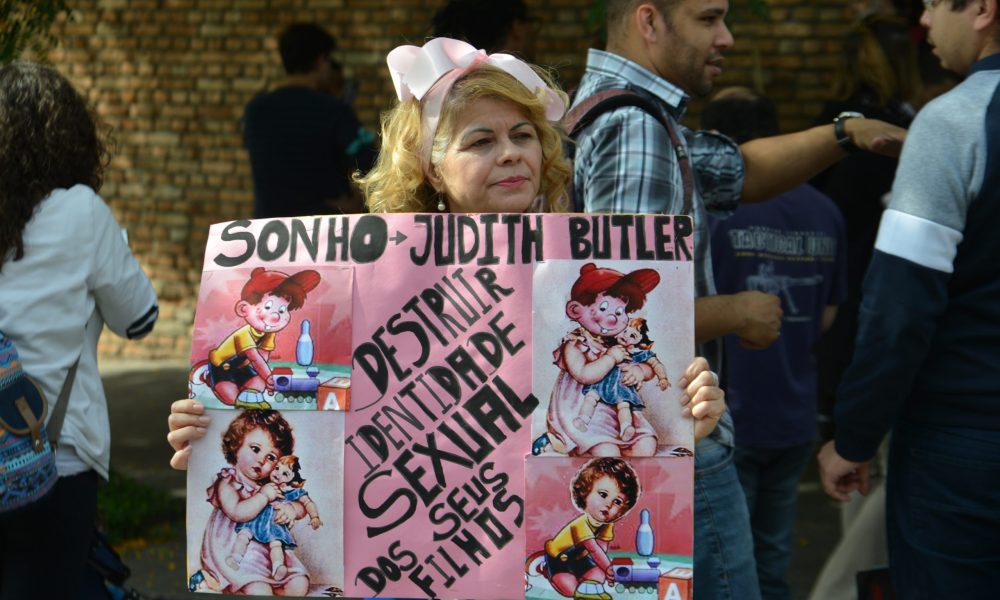
Fascism’s Building Blocks: 30 Years of Destroying Families
“Women—who disproportionately carry the burden of caregiving and are often left alone when partners are kidnapped—are pushed into deeper poverty and isolation.”


-

Homing Empire
Family memoirs are a special kind of historical offering. They have the power to tell fine-grained stories of the past, of epochal events—wars, migrations, empires—and to intricately connect them to the lived present of the author who reconstructs them. Done well, memoirs people the past, putting their reader in touch with affects, intentions, and relations…
-

How Families Navigate Empire
Beginning at the end of the 1960s—in what we now call the start of the feminist Second Wave—women, especially black women, began making scholarly …
-

Identity, Islands, and Hazel V. Carby
What histories do we inherit? In the current crisis of Brexit—which points to larger global shifts toward nationalism and xenophobia—there is no more urgent a …
-

“Who Inherits?”: A Conversation between Tao Leigh Goffe and Hazel V. Carby
Over the decades of her transatlantic career, distinguished Yale University professor emerita of American and African American studies Hazel V. Carby has considered how one negotiates ancestral ties to two islands intimately entangled by empire, Britain and Jamaica. Her new book, Imperial Intimacies: A Tale of Two Islands, is her answer to that question. As…
-

Another Mormon Education
The first sentence Tara Westover writes in her engrossing memoir Educated is a disclaimer: “This story is not about Mormonism.” This is true in the same …
-

The Book That Made Me: An Animal
The Lives of Animals was the first book I read in college—or at least the first book I read in a strange, amazing seminar that rewired my brain in the first semester …
-

Adoption Anxieties
Given the overall paucity of novels about interracial adoption, it is striking that no fewer than three were published in 2017. In general, reviewers warmly received Shanthi Sekaran’s Lucky Boy, Lisa …
-

Japan’s Isolation 2.0
The taxi driver who took me from Tokyo train station to my hotel had turned his cell phone sideways, like a television, and propped it up on the dashboard of his car. He was watching a historical drama set in the Edo period (1603–1868); the hero was walking a footpath that had connected Edo (Tokyo)…
-

Ireland’s Uneasy Monuments
“History,” writes Fergal Keane, “began with my father’s stories.” These were stories of Oliver Cromwell’s murders, of the dead of the Irish Famine, of wars of …
-

Keyword of the Week: Mothers
It’s Mother’s Day on Sunday! If you know a mom who loves to read, send her this week’s Public Bookshelf. It features four of our favorite PB articles about motherhood, including a review of Alison Bechdel’s Are You My Mother?, and an essay on Sally Mann’s extraordinary family photography. The Bingewatch: Mother Winona 9.15.2016 Sarah Kessler Since its release in mid-July, Stranger Things,…
-

Lin-Manuel Meets “Moana”
Disney’s new animated film, Moana, with songs by Hamilton genius Lin-Manuel Miranda, arrived last weekend to great expectations. Would it keep Disney’s musical franchise afloat? Would it continue …
-

The Model-Minority Bubble
Perhaps the most famous shopping trip in American literature can be found in Don DeLillo’s 1985 novel White Noise. Wounded by a colleague’s unflattering assessment of his appearance, Jack Gladney turns to impulse buying as a form of self-help. “The more money I spent, the less important it seemed. I was bigger than these sums,”…
-

Code-Switching: An Interview with James Hannaham
Might a stand-up comedian discuss slavery in America with considerable doses of humor? Happens all the time. A contemporary novelist? Not so much. It is the rare writer who is willing to approach the topic without the requisite gravitas. In James Hannaham’s Delicious Foods, a harrowing tale of slave labor in the contemporary United States,…
-

All About My Mother
In her canonical 1939 essay, “A Sketch of the Past,” Virginia Woolf wonders how a coherent past may be reconstructed from countless angles, styles, and past selves. How do we choose from so many snapshots and memories? And how do we differentiate ourselves from the people and surroundings that shaped us? Woolf ultimately decides to…
-

Louise Erdrich’s Hard Facts
Early on in Louise Erdrich’s most recent novel, LaRose, the priest on the reservation articulates a worldview that encapsulates an enduring theme of this novelist’s work: “some people would try their best but the worst would still happen.” Many writers would mine this observation for tragedy, but Erdrich instead turns to healing. In book after…
-

The Church House on Cannaday School Road: Floyd, VA
This is the latest installment of Public Streets, a biweekly urban observations series curated by Ellis Avery. Floyd, VA, sits at the intersection of State Highway 221 and Route 8, in the southwest point of the state. The sole stoplight in Floyd County guards that intersection, watching over the courthouse, an unadorned 20th-century clump of…
-

Analytic Rage: The Genius of Jenny Diski
I picked up a copy of Jenny Diski’s first novel, Nothing Natural, at random a few decades ago at an airport bookstore. I read it on the flight from Heathrow to JFK with a degree of shocked engrossment unprecedented in my reading experience. Nothing Natural, a brilliant and claustrophobic tale of female intelligence and female…
-

“A Writer Should Never Get Over How Embarrassing This Is”: A Conversation With Adam Ehrlich Sachs
Adam Ehrlich Sachs’s debut novel, Inherited Disorders, makes its method visible to you as you read: you watch the book, feel it turning itself inside out in order to say something worth it. Its preoccupations—its stumbling blocks, but also its most beloved themes—are literally announced in the titles of the 117 tableaux that make up…
-

The Bingewatch: It’s Never Just a Dress
My ongoing love affair with TLC’s Say Yes to the Dress began about two months ago, when a close friend prescribed the long-running reality show as a remedy for my encroaching PhD graduation anxiety. It was May, and thus also the cusp of wedding season, making SYTTD a particularly timely recommendation. I’d been beset by…
-

Stumbling Over a Violent Past
When Jennifer Teege was 38, she discovered a book in Hamburg’s central library that dramatically transformed her self-conception and her life: I Have to Love My Father, Don’t I? The book concerned the daughter of a prominent, infamous Nazi. That woman, Teege realized with shock, was her own mother, Monika. In that moment, Teege went…