Tag
Visual Culture
-
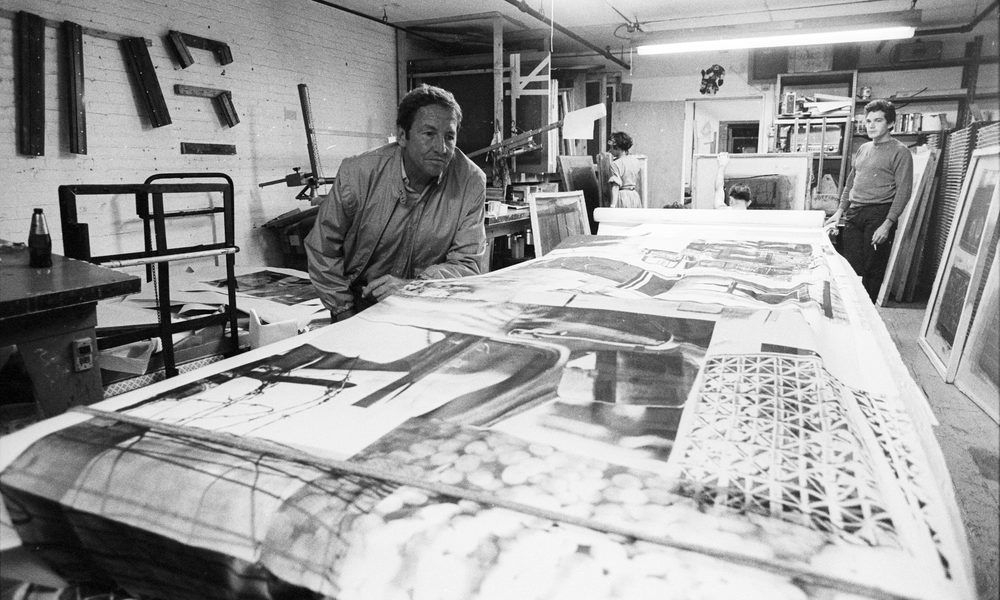
Use and Reuse: Dancing Again with Robert Rauschenberg
“Looking at the Rauschenberg archives was a revelation to me. I’ve never handled a silkscreen, and physics and geometry weren’t my best subjects in high school, but even I could see how ‘Set and Reset’ could be recreated because of the Rauschenberg studio’s meticulous records management.”


-
Summer in Snow Country: A Sound and Photo Essay
This is the latest installment of Public Streets, a biweekly urban observations series curated by Ellis Avery. Less than two hours from Tokyo Station by bullet train, the village of Osaki is nonetheless a country backwater. The town lies aside narrow Route 291, which snakes and tunnels its way to Yuzawa, the onsen (hot spring)…
-

Otherworlds
In the history of modern comics—as in the history of comic’s cousin, film—there have long been two competing impulses. Film history contrasts the styles of two pioneers: the documentary realism of the Lumière brothers and the magical stagecraft of Georges Méliès. In comics, we can find a parallel fork in the road in the pioneering…
-

Edible Comics
Comics and food have a longstanding relationship, most spectacularly in a unique genre known in Japan, its country of origin, as ryôri manga, or cooking comics. These are comics entirely devoted to food—its preparation, its appreciation. Today we can find food comics in France and the US, but this is a genre that traces its…
-
Public Picks 2014
Welcome to the second annual edition of Public Picks, a selection of the books and art that most interested and excited our editorial staff over the past year. As in last year’s Picks, we aimed for a list that combines the best of the best with more idiosyncratic works that you may have missed. With admiring nods to…
-

Carrie Mae Weems at the Guggenheim
The Carrie Mae Weems retrospective cries out for the spiral at the Guggenheim. But instead 30 years of work, asking bigger and bigger questions, is split across two side galleries two floors apart, while the Italian Futurists bluster their way up the curved ramp. On the lower level are Weems’s family pictures from 1978–1984, their…
-

Futurist Cheerfulness
In the domain of games and toys, as in all passéist manifestations, one sees only grotesque imitation, timidity (miniature trains, little cars, dolls that can’t move, cretinous caricatures of domestic objects), things that are monotonous and discourage exercise, prone only to dishearten children and make them stupid. — Giacomo Balla and Fortunato Depero, “Futurist Reconstruction…
-

Changing Landscapes
The Museum of Modern Art recently completed its 13th annual Documentary Fortnight, a two-week festival of international nonfiction film. In a city flush with film screenings, the Fortnight is notable for its wide-ranging social interests as well as its commitment to the limits of documentary form. “So much that defines documentary today is about the…
-

At the Wall
The title of Donna Tartt’s latest best-selling novel comes from a painting of a small bird by Carel Fabritius that hangs in the Mauritshuis in The Hague. A student of Rembrandt’s and an influence on Vermeer, Fabritius had his career cut short by a gunpowder explosion in 1654 that also destroyed almost all of his…
-

Origin Stories
There are many mornings when I cannot help but express my gratitude that I did not come of age in this current generation. As a father of two Millennials and a teacher of hundreds more, I know that any one of the unprecedented hurdles they face—from the grim face of global extinction to the savageries…
-

The Democratic Surround: A Conversation Between Fred Turner and Clay Shirky
Last December, Public Culture senior editor Fred Turner sat down with Clay Shirky, the author of Cognitive Surplus: Creativity and Generosity in a Connected Age and Here Comes Everybody: The Power of Organizing Without Organizations, to talk about Turner’s new book, The Democratic Surround: Multimedia and American Liberalism from World War II to the Psychedelic Sixties. A prequel to the influential From Counterculture to Cyberculture which…
-

Working Girls
“A friendship between college girls is grander and more dramatic than any romance,” writes Hannah Horvath (played by show creator Lena Dunham) in the final episode of the second season of the HBO series Girls. This literary gem is the first, and only, sentence of an ebook for which Hannah has already received and spent…
-
The Restless Storyteller: An Interview With Laura Bolaños Cadena
Historia Semanal de Amor y Pasión (Weekly Story of Love and Passion) is one of those pocket-size Mexican comic books you may have read or seen—they’re called historietas. The covers are illustrated in eye-popping colors, and the drama inside is high and often fast. One of the most twisty and gripping issues I’ve read contained…
-
Alexis Rockman: Drawings from Life of Pi; with A Letter to the Artist
Public Books is pleased to present our first collaboration with the Lyon-based cultural institute Villa Gillet in connection with their fall Walls and Bridges festival in New York City. From October 9 to 20 the festival will celebrate critical inquiry and performance by French and American thinkers and artists from across the humanities, social sciences, and arts. Public Books is…
-

All About the Clothes
Though Grace Coddington is well-known in her native Britain by lovers of London’s Swinging Sixties, most Americans only learned who she was from the 2009 documentary about the making of Vogue’s annual landmark, The September Issue. This despite the fact that she has worked at American Vogue since 1988, and arrived there on the same…
-
Wanting Out
I can remember the first time I met Mark Anthony Neal. I was a graduate student, and he was visiting faculty at the University of Pennsylvania, teaching a class entitled “(Il)Legible Blackness.” The course aimed to familiarize students with recent work in black aesthetic theory and included discussion of a wide range of artists and…
-

War Stories
Today anyone with a computer or smart phone can access videos of armed conflicts from around the world. Battles that would once have been shared days, years, or even generations after the fact, via newsreels, books, or folksongs, are now available for immediate consumption anywhere, anytime. But is anyone watching? Recent wars have proven to…
-

Game of Chance
The narrator of Alexandra Chasin’s novella, Brief, displays a close rhetorical kinship with Vladimir Nabokov’s Humbert Humbert. An art vandal of indeterminate gender, s/he defends an act of destruction inflicted on a work in the “midtown temple of Modern Art” through verbal flourishes that rival, and sometimes directly echo, the nymphet-lover’s pleas to his readers…
-
Social Change Sensibilities
In Sensible Politics, Meg McLagan, a cultural anthropologist and independent filmmaker, and Yates McKee, a writer and scholar, provide an intriguing collage of essays and interviews by scholars, activists, artists, filmmakers, and architects that explore the inextricable linkages between visual culture and nongovernmental politics. In the introduction to this edited volume, McLagan and McKee write:…
-

Soldier Exposures and Technical Publics
In this collaborative visual essay, we consider an idiosyncratic assemblage of pictures of American soldiers. These are not iconic images that “speak for themselves” but less conventional ones that suggest both the technical expertise involved in producing and managing war’s violence and the vulnerability of soldiers at the heart of war. In considering these images…
-
Mapping a Young America
Maps are ubiquitous now, embedded in nearly every mobile device, but in the early days of America, maps were far more precious. In Mapping the Nation, Susan Schulten argues that the formation of the United States allowed cartography to become an institutionalized practice in the country. At the same time, and perhaps more importantly, the…