Being reviewed:
Advertisement

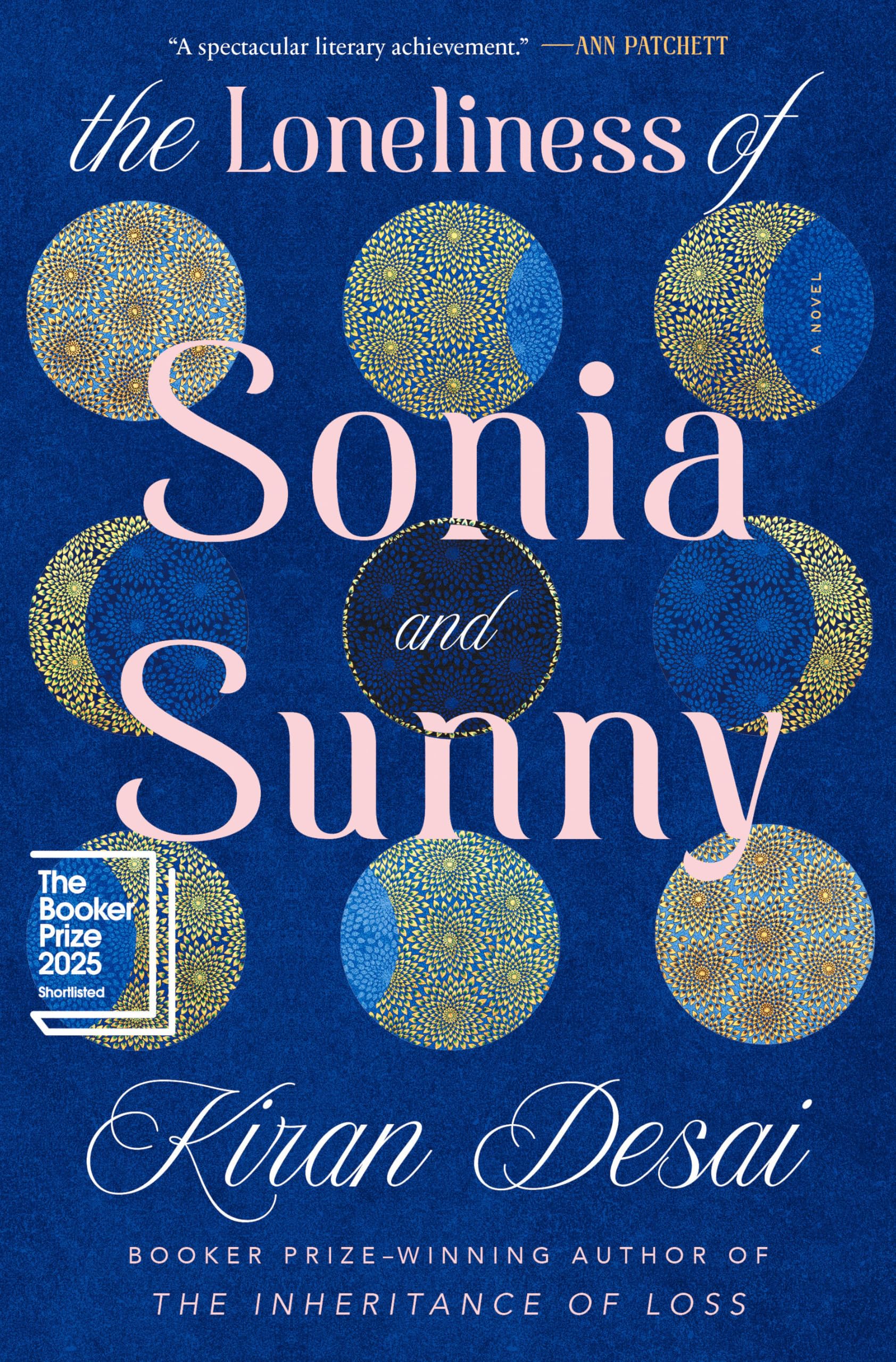
Sonia and Sunny first meet only a third of the way through Kiran Desai’s sprawling, Booker-nominated novel, The Loneliness of Sonia and Sunny. On a night train through north India, the characters’ meeting feels like fate, as their grandparents had tried (unsuccessfully) to arrange their match when they were both in the United States. Now this accidental encounter sets a romance into motion. Sonia and Sunny have much in common: both are young aspiring writers from the same cosmopolitan urban middle class, and they yearn for a sense of belonging. This sense has eluded them—despite their material advantages—in both India, where they grew up, and the United States, to which they travel during the 1990s for education and for work. In India they feel guilty about their economic privilege and Western education, which distances them from much of the population; and in the US they feel the shame of being “Third Worlders,” coupled with despair over, what they perceive as, deep incompatibility between Indians and Westerners. Interestingly, Desai’s postcolonial novel does not apologize for deploying this old colonial trope: indeed, abandoning the self-consciousness it brings to so much else, it traffics in the belief that there is a basic, implacable, civilizational difference between East and West.
Sunny, of all the characters, is most prone to thinking in terms of such difference. He sees a fundamental opposition between his own “civilization” and that of Ulla, a white American woman from Kansas with whom he had a failed relationship. He also sees Indians as distinct from Americans, declaring that those like him who grew up in postcolonial India “are not taught how to leave [relationships], nor how to be left.” Other characters advance similar theories; Sunny’s uncle, for example, proclaims that “Western psychology is no match for an Indian family. We are too slippery, we change shape, we don’t distinguish truth from lies.”
Throughout Desai’s impressive multigenerational saga, the narrative voice usually intervenes into all sorts of perceptions and misconceptions of its characters. And yet, regarding the culturally essentialist theories of Sunny and others, that same voice refrains from ironizing. Indeed, in some instances, it even affirms such theories. This comes through especially in how it portrays interracial romances—the only interracial relationships depicted in depth—as inevitably doomed to failure. Ulla and Sunny are proven to be incompatible on all manner of subjects: from their food preferences to attitudes towards family and intimacy. Meanwhile, the artist Ilan, Sonia’s white European lover, emerges as a cartoonish villain, who appropriates for his art her amulet of an eyeless deity, given to her by her family. Sunny’s heroic retrieval of the amulet for its rightful owner serves as a naked device that confirms his superiority over his white male rival and moves the narrative to closure.
When Sonia’s relationship with Ilan breaks down, her US employer, Lala—who is prone to think of all groups through racial stereotype—advises Sonia to return to India to put her “education to best use.” She promises Sonia, “The scope of your life will broaden in your own landscape, however counterintuitive this may seem now.” Although Lala has a conservative, even racist, worldview, her advice nonetheless functions as a foreshadowing of sorts, its soundness confirmed by the novel’s conclusion. Hope, as the novel construes and frames it, lies mainly in returning to one’s roots, and to one’s kind.
And indeed, as Sonia and Sunny find themselves feeling crushed under the weight of a neocolonial white gaze, they are left with little choice but to return and recommit to India. In this way, as a Booker Prize judge put it, a “novel about Indians in America becomes one about westernised Indians rediscovering their country, and in some ways a novel about the Indian novel’s place in the world.”1 All of which leads me to wonder about the dynamic between postcolonial fiction and the Booker, the UK’s foremost literary prize, which increasingly shows self-consciousness about its origins in colonial capital and a desire to publicly reckon with this history and its impacts on formerly colonized populations like India’s.
To what extent might the Booker, and venues like it in Europe and the US, be drawn for self-serving reasons to fiction like Desai’s? Drawn, that is, to not just its literary qualities, but also its particular performative mode of historical reckoning that aligns with their own priorities? And, in what ways might these politics and priorities of institutions that reward and market postcolonial fiction in the advanced capitalist world be informing the style, mood, and emphases of this fiction? To raise such questions is to consider Desai’s novel in context: that is, to read with it but also reach beyond it into the conventions and expectations of postcolonial writing that circulates in the global marketplace.
The Loneliness of Sonia and Sunny begins in 1996, alternating between the protagonists’ experiences in a post–Cold War United States and those of their family members in post-liberalization India. It ends in 2002, with a rightward turn in both nations, and with Sonia’s and Sunny’s futures uncertain. In this present moment—when right-wing nationalism wreaks havoc around the globe, and when the fate of migrants is the stuff of daily news—the novel will strike many as timely. But for those familiar with internationally circulating fiction from the formerly colonized world, fiction that often carries the label “postcolonial,” Desai’s novel and its dislocated protagonists may read instead as conventional.
As an Indian who came to the US around the same time as the novel’s protagonists, I was drawn to its exploration of the psychic landscape of contemporary globalization. Desai’s elegant prose made it easy to become absorbed in the various settings this prose so vividly illuminates and in the lives of its many colorful characters. The most compelling of these, I found, are some of the minor ones like Sonia’s divorced aunt Mina Foi, whose constricted existence in Allahabad is depicted with much tenderness, and Sunny’s widowed mother Babita, whose obsession with social status is made delightfully comedic.


But when it came to the central characters, I could not get past a strange hollowness in their construction. To me, Sonia and Sunny seemed more like devices, designed to prove that colonial shame continues to haunt Indians (and Indian writers) living abroad. This shame is the “inheritance” Desai explored in her 2006 novel The Inheritance of Loss, for which she won the Booker Prize. In her latest work—shortlisted for the same prize—shame reappears as taproot for the “loneliness” the protagonists experience as they navigate racial stereotyping, mainly in the US.
Sonia and Sunny seem to be modeled on a stock figure within postcolonial fiction: the anxious expatriate, whose emblematic examples include Mustafa Sa’eed in Tayeb Salih’s Season of Migration to the North, Antoinette Cosway in Jean Rhys’s Wide Sargasso Sea, and Saladin Chamcha in Salman Rushdie’s The Satanic Verses. As anxious expats, Desai’s protagonists are burdened by history, caught between imagined geographical and cultural categories—“East” and “West”—that were a hallmark of colonial discourse and that continue to pervade contemporary thinking.
But in addition to playing the role of anxious expats, Sonia and Sunny appear designed to function as author surrogates. Their bouts of writerly shame and guilt, and their ethical quandaries, occupy much narrative space. In a recent interview, Desai, who is herself part of the Indian diaspora, succinctly described these quandaries as being about “who owns the story, who tells the story and who is captured by whose gaze.”2 Readers of The Loneliness of Sonia and Sunny may well detect a similar—questioning, but also embattled—authorial voice lurking behind the central characters, enabling the novel to expose the dilemmas facing the expat author who represents India in the global sphere.
A journalist who uses stories from India to launch his career in the US, Sunny—like Desai, perhaps—worries about being “a brown person going to the brown world to tell the white world about the brown world.” His sensitivity to racial inequities is strengthened by bouts of shame over his failed relationship with his white girlfriend. Ultimately, Sunny submits a guilt-ridden essay to a “competition held by the writers’ organization PEN”—and ends up winning an award for his efforts. In this episode, the novel ironizes the diasporic writer’s instrumentalization of authorial guilt for professional advancement.
Hope, as the novel construes and frames it, lies mainly in returning to one’s roots, and to one’s kind.
But it is Sonia’s position as a budding novelist that most closely resembles Desai’s. The character anguishes over what she can write that won’t simply feed “the West what it want[s] to consume about the East.” This anguish is exacerbated by her abusive relationship with Ilan, who is many years her senior. Ilan sees Indians as an “ashamed people,” and from this he assigns himself moral authority to in turn shame Sonia by telling her, “What Westerners did to you, you are doing to yourself.” Ilan invades Sonia’s consciousness with injunctions: “Just don’t write magic realism nonsense.… Just don’t write orientalist rubbish. Just don’t write about arranged marriages.” Sonia worries about these injunctions, and also about how she might one day relay the story of her relationship with Ilan, fearing that any attempt at doing so “would fall into a tedious stereotype of older, monster male artist and younger, aspiring female artist.” As it does with Sunny’s worries, the novel uses Sonia’s distress to show its awareness of the charges of orientalism and stereotyping levied against expatriate writers like Desai.
And yet—despite Ilan’s admonitions, or perhaps because of them—Desai’s novel draws briefly on the techniques of magical realism and also features an (attempted) arranged marriage. This means that by incorporating Ilan’s injunctions, exposing them as censoring of the expat writer, and then pushing against them, The Loneliness of Sonia and Sunny justifies its own reliance on conventional modes of representing India in the West.
Fiction like Desai’s has long proven popular in the global literary marketplace, especially with institutions like the Booker Prize. The Prize’s website speaks openly of its origins in a 19th-century slave-owning food distribution company in British Guyana, acknowledging the potential “impact of the past on racial inequity in the present.”3 Given the institution’s desire to contend with its history in a clearly visible manner, it is possible that by choosing to nominate or reward work like Desai’s, Booker judges are, “even on an unconscious level,” as Claire Squires puts it, “consider[ing] the extent to which readers will appreciate their choices, as well as thinking about how their choices reflect back on Booker tradition.”4
In other words, selecting fiction like Desai’s—that explicitly deals with the impacts of colonial histories—allows the Prize to define the “Booker tradition” in terms that broadcast some sort of collective reckoning with these histories. Moreover, the institution’s various platforms for celebrating and promoting selected works provide it with an opportunity to itself perform public expiation for the historical injury represented in these works.
But not all postcolonial fiction might be equally attractive to Booker judges in this regard. Ronit Frenkel detects a preference in the Booker tradition for fiction that not only engages the colonial past but does so specifically by “fulfill[ing] Western stereotypes of … post-colonial pathos.” By drawing on South African and Indian fiction shortlisted for the 2006 prize—including Desai’s The Inheritance of Loss, which won the prize—Frenkel points to how selected works tend to depict postcolonial contexts as “places of bitterness … [that are] overwhelmed by their histories and marked by the triumph of loss or instability over love or redemption.”5
“Postcolonial pathos” strikes me as an apt encapsulation of both the mood and the mode of representation that underwrites The Loneliness of Sonia and Sunny. This mode delivers a collective experience in which psychic residues from historical injury seem to dominate, leaving little room for love. The rewarding of this mode of representation then becomes a way of, in Graham Huggan’s words, “prizing ‘otherness.’”6 whereby the postcolonial world is at once included, celebrated, and yet rendered unthreatening because of, what is seen as, its categorical separateness from the West.

But is Desai’s novel, then, fulfilling stereotypes of the postcolonial world as forever “other”—exemplary of a wounded, stagnant East that is fundamentally incompatible with a dynamic West? If this is true about the novel, then it is a telling illustration of how literary texts in general are not simply autonomous works of solitary genius, but always produced by authors in interaction with prevailing cultural and market forces and expectations.
More specifically, though, Desai’s novel might be seen as an exemplary product of a “field of postcolonial production,” whose politics, notes Sarah Brouillette, often “make their way into the literary works … whether as theme, technique, or figural residue.”7 This notion of a “field of postcolonial production” strikes me as helpful. For, in addition to enabling a view of individual works as not simply idiosyncratic, it opens up the possibility of imagining how writing outside the field might alternatively render postcolonial experience. All of which creates room to conceive of this experience otherwise—including in ways that need not reify racial and cultural divides, and that might even demonstrate the possibility of crossing such divides, whether through solidarity, or through love. 
This article was commissioned by Tara K. Menon.
- The Booker Prizes, “The Booker Prize 2025 Shortlist: What Our Judges Said,” September 23, 2025. ↩
- Rida Bilgrami, “In Conversation with ‘The Loneliness of Sonia and Sunny’ Author, Kiran Desai,” September 26, 2025. ↩
- The Booker Prizes, “The Booker Brothers and Enslavement,” April 24, 2024. ↩
- Claire Squires, “Book Marketing and the Booker Prize,” in Judging a Book by its Cover, Eds. Nicole Matthews and Nickianne Moody (Routledge, 2007), p. 96. ↩
- Ronit Frenkel, “The Politics of Loss: Post-Colonial Pathos and Current Booker Prize-Nominated Texts from India and South Africa,” Scrutiny2: Issues in English Studies in South Africa, vol. 13, no. 2 (2008), p. 77. ↩
- Graham Huggan, The Postcolonial Exotic: Marketing the Margins (London/New York: Routledge, 2001). ↩
- Sarah Brouillette, Postcolonial Writers in the Global Literary Marketplace (Palgrave, 2007), p. 176. ↩