
Advertisement

This past year has marked the centennial of visual artist Robert Rauschenberg, born October 22, 1925. In honor of the centennial, the Trisha Brown Dance Company returned to the Brooklyn Academy of Music to perform Set and Reset, first staged at BAM in 1983. With a set and costumes designed by Rauschenberg, the dance has been performed many times since its 1983 premiere.
But for the 2026 Dancing with Bob program, the Trisha Brown Dance Company had to reconstruct Set and Reset without Rauschenberg or their founder’s help. The original decor had been deposited with Tate Modern in 2022 for safekeeping but were no longer usable for future dances. This was because, as Company programming director Jamie Scott put it in an interview with ArtNet, “maintaining a dance is quite different from maintaining objects.”
At first consideration, this idea is counterintuitive. Objects have a fixed form, while dance is the ephemeral art par excellence, with no script like drama and no standardized notation system like music.
But if you journey into Robert Rauschenberg’s archives, these particular objects clearly challenge efforts to preserve them. The costumes were printed with delicate silkscreens and fabricated from satin, vulnerable to wear and tear from bodies flinging their limbs à la Brown. And the many, many parts of the aluminum sculpture suspended over their heads would have to be disassembled and reassembled—surely some would be misplaced over the years. Still, why did the Company reuse this mise-en-scène until it becomes unusable, and then undertake the complicated—and surely expensive—task of reconstructing them? Is it easier to recreate a dance than a costume? And why would you want to anyway?
Recreating Rauschenberg’s designs required turning archival records into living contributors to the creative process, revealing how production design is essential to meaning making.
Recreating Rauschenberg’s work of a half-century ago could be seen as confirming that that era’s vibrant avant-garde scene has calcified into a museum piece. Indeed, Brown and Rauschenberg’s first collaborations in the 1980s were viewed at the time as the sign of the end of New York’s radical art making of the 1960s and 70s. Originally, Brown had made a name for herself by staging dances across the rooftops of SoHo; so her migration to the proscenium stage prompted New York Times dance critic Anna Kisselgoff to quip that “In 1981, we have finally realized that the 1960’s are over.” How truer that might seem in 2026: Preserving and reconstructing original productions is more characteristic of repertory ballet and opera, and bringing the same process to Rauschenberg’s designs implies that they’ve become akin to a stale Zeffirelli set at the Metropolitan Opera or the Balanchine Nutcracker you can depend on looking the exact same every year at New York City Ballet.
I view today’s reconstructions differently: not as an enshrining but as a revival. Recreating Rauschenberg’s designs required turning archival records into living contributors to the creative process, revealing how production design is essential to meaning making. Rauschenberg sought to close the gap between art and life by literally filling his artworks with stuff from the real world, and in Set and Reset, Rauschenberg’s costumes and set pieces give concrete meaning to Brown’s geometric abstractions. The result is a performance that imagines the organic and the engineered—the costumes are silkscreened with photographed details of New York buildings—as entering into a relationship of mutually beneficial balance rather than destructive competition.
Reuse is a pragmatic decision, but it’s also an aesthetic and an ethics. Rauschenberg found beauty in the banal engineered objects that punctuate the urban landscape, such as the window cornices silkscreened on the Set and Reset costumes, and Dancing with Bob celebrates reuse by following Brown’s cerebral piece with the exuberant Travelogue. The Cunningham piece turns Set and Reset’s philosophy of reuse into practice by starting with its dancers posed on a moving platform of bolted chairs interspersed with bicycle wheels.
After the program at BAM, I found myself looking at the city in a new way, seeing line and shape in the vistas outside the M train as it hurled toward Manhattan. My destination, SoHo, has become a very different place since Trisha Brown danced on its rooftops. An epicenter of urban renewal, SoHo symbolizes a consumerist approach to city living that satisfies its thirst for trends by demanding novelty. This approach is, obviously, wasteful. But what if we replaced urban renewal with urban reuse?

Let’s start with the dance. A disclaimer: Like Rauschenberg, I’m not a trained dancer, but I am an enthusiast for the discipline, because of how it turns the body into an artistic medium. The performance begins with a ceremonious tableau of three dancers walking across the rear of the stage as they carry another dancer upon their heads. Once they reach stage left, they begin weaving around the translucent fabric columns placed in the wings; suddenly, a different dancer runs across from stage right, flips into a handstand, and is caught in another dancer’s arms.
The sharp contrast between tight choreography and surrendering to the forces of gravity plays out again and again in the piece that follows. Set and Reset showcases the body not just as a medium, but as a mechanism: simultaneously responsive to conscious direction and propelled by instinctive reflexes.
Being mechanical does not mean being rigid. Across her work, Brown devised choreography by issuing a set of simple rules and joining her dancers in extemporaneously interpreting them. The resulting shapes would then be repeated and recombined, as Brown slowly transformed organic movement into a built piece. These shapes often test the body’s ability to twist and extend, and Brown wanted her dancers to follow their bodies’ instincts in resolving each phrase.
In one repeated shape in Set and Reset, dancers dive into arabesques that end up looking like the Warrior Three pose in yoga due to the verve with which they extend both arms. To rebalance, bodies bend forward toward the ground or the lifted leg plants itself down and bends the body backward. The spine ends up looking like another limb, as supple and capable of extension as the swinging arms and legs that characterize Brown’s style. The fabric columns they interact with, evocative of urban skyscrapers, become equally fluid. Equilibrium is ultimately achieved through constant movement, not static poses or rigid scaffolding.
Nor does synchronicity look like a disciplined, assembly line-like chorus. Sometimes, dancers stand together while performing the same phrase, as if the shape was transposed along a horizontal axis by a few feet. Just as often, they perform the same phrase while oriented at 90- or 180-degree angles from each other. In one duet, two female dancers jump into the same high kick, but then they spin into opposing directions. When they repeat the high kick, the effect is like a geometric figure reflected along an imaginary y-axis. Synchronicity ends up looking like inversion—even antithesis. Set and Reset’s use of antithesis turns repetition into something dynamic and capable of producing something new, just as Brown’s dancers create new shapes by allowing the tension between choreographic direction and the body’s instincts as an organic mechanism to intuitively resolve itself. Even transposed shapes look like variation due to differences in physique and learned deportment.
If this sounds a bit abstract, then Rauschenberg’s designs bring it down to earth.
Trisha Brown choreographed for the built environment. In Set and Reset, this built environment is the rectangular prism of the proscenium stage, whose edges and corners the dancers cluster around and mirror in the 90- and 180-degree angles of their limbs. Through Rauschenberg’s designs, that built environment also becomes New York City.
Rauschenberg’s designs visualize the interplay between the organic and engineered that animates Brown’s choreography. On the surface of the costumes, urban imagery is emancipated from its usual association with rigidly repeating intersecting lines. The so-called “Modernist grid” appears, but so does a fleur de lis-like pattern and undulating barbed wire (on the top first worn by Trisha Brown herself). Even the Modernist grid becomes mobile on one pair of culottes. Square tiles appear at the hem and appear to rotate through the neighboring image of a wired fence.
And because these costumes are worn by dancers, the engineered becomes fluid. Fabricated from translucent satin and cut off at the calves, the culottes gather around the thighs and expose most of the leg whenever a dancer kicks. Contortions alter the lines of the silkscreened patterns, and because the company is lit low and from the sides, the visibility of the images constantly changes. Sometimes, they appear internally lit and turn the dancers’ bodies into screens, but other times, the contours of the body show through.
Neither urban engineering nor the human organism dominates the stage spectacle. Instead, one concedes prominence to the other and then takes that precedence back again.
The silkscreened costumes aren’t the only moving images that appear onstage. At the start of the piece, a large cloth-covered aluminum structure consisting of two pyramids and a rectangular prism sit on the floor, its surface covered with projected footage from industrial and educational films. Eventually, the structure—which Rauschenberg called Elastic Carrier (Shiner)—levitates, as if a participant in the dance; then, the dancers’ bodies enter the stage space the engineered object had occupied. For the rest of the performance, it hangs suspended over the dancers’ heads, mirroring their movement yet threatening to injure them should it fall.
It’s a bit difficult to discern every image on the Shiner during performance, but they can be easily seen in the original footage at the Rauschenberg Foundation’s archives.1 When I first looked, the montage appears to turn the interplay between the organic and the engineered into the Modernist opposition between the natural and the industrial. A close-up of a turtle cuts to the sinking of the Hindenberg, and a shot of a space shuttle launching makes way for a shot of the Arizona desert. Industry acts as a source of injury and destruction in much of the footage, such as a shot of a man becoming electrocuted after fixing a telephone wire. But it can also have a peculiar beauty, seen in so many shots of spaceflight.
In performance, these Modernist oppositions merge. The Shiner sculpture circumvents film editing’s inability to show multiple shots simultaneously through the five projectors placed in the stage space, and their angled positioning makes the images overlap. That overlap made me think of Dziga Vertov’s Man with a Movie Camera (1929), a seminal work of Soviet montage in which Vertov’s cinematographer brother Mikhail Kaufman places his camera in the nooks and crannies of Odessa, Moscow and Kiev in order to help the viewer perceive the details of city life that are visible yet usually unseen. Vertov called this mode of seeing the “kino-eye,” and Rauschenberg sought the exact same effect in his own work. But while Movie Camera overlays moving images in only a few choice moments, the construction of the Shiner turns simultaneity and overlap into a constant. Soviet montage is widely viewed by film historians as the cinematic counterpart of Marxist dialectical analysis, in which social life is understood as a series of oppositions (between a “thesis” and “antithesis”) that will bring about progress once the merits of the opposing forces are integrated (called “synthesis”). Film editing is better at showing antithesis than synthesis, but Rauschenberg’s manipulation of theatrical exhibition overcomes this limitation.
Brown’s dance does not—cannot—literally represent what a less destructive society (produced by the synthesis of the organic and the engineered) would look like. And yet, Brown’s interest in the body as mechanism and its interaction with the built environment can model a different kind of relationship between them: a search for equilibrium that never takes it for granted that it’s finally been achieved.

After its 1983 premiere, Set and Reset immediately entered the Trisha Brown Company’s repertory, and Rauschenberg’s designs entered into their custody. In conversation with me, Company director Jamie Scott explained how constant reuse led to occasional reconstruction. Rauschenberg’s studio built a smaller Shiner that could more easily tour and rebuilt it years later, and the costumes were eventually reprinted at Rauschenberg’s Captiva property in Florida. The wear and tear caused by the human body on Set and Reset’s decor is fitting for a piece about the reciprocal mutability of the engineered and the organic, but it poses a problem for indefinite reuse.
The costumes deposited at the Tate could have been used for the BAM program, but as Jamie Scott explained to me, the Trisha Brown Dance Company wanted something that could be reused in the future (future performances of Dancing with Bob are already on the Company’s calendar). Learning this got me thinking about why legacy dance companies can model a more sustainable approach to production design—especially when those designs are rooted in the aesthetics and ethics of an artist like Robert Rauschenberg.


Anyone who has been involved with producing performance can tell you that it’s a costly affair. And for avant-garde performance, there are usually no long runs to justify investment given the challenges of funding ephemeral work. If new pieces are actually built or sourced, they might be sold as autonomous art objects, or languish in a storage room somewhere, at risk of becoming forgotten and then lost. Reuse in performance, to my understanding, is uncommon.
Except if you’re a dance company whose mission is to conserve your founder’s groundbreaking dance language and setting is an essential part of that founder’s work. Legacy companies have a peculiar identity because they tour with a repertoire, but instead of preserving tradition, they keep an uncodified dance language alive and enable new dance languages to emerge when company members become choreographers. Not all avant-garde performance pieces are intended to be restaged like Set and Reset, but the combination of scenic reuse that its production history illustrates and the particular vision of urban engineering offered by Rauschenberg’s designs is, to me, an invitation to challenge the commercial stage’s monopoly on worldbuilding by thinking creatively about reusing materials. They could be from another production, or they could be from the environment around you, as Rauschenberg did in so many of his collaborations with Merce Cunningham.

Because the artist himself is no longer alive, the Archives team at the Rauschenberg Foundation became the Company’s new collaborator for the 2026 program. The Foundation still held one roll of reprinted fabric along with some damaged silkscreens and the original negatives. From this material, the collage could be recomposed and sent off to a digital printer. The Company had previously had the Shiner replicated, and projections had already been recreated from digitized surviving film reels after the Company’s 16mm copy had become brittle from constant reuse.
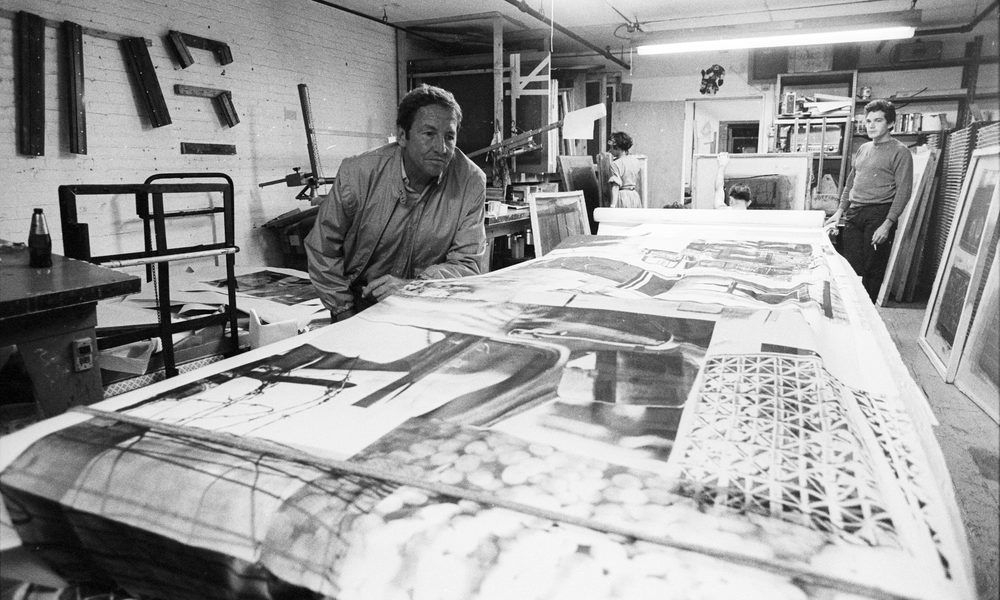
The amount of surviving material from which Set and Reset’s designs could be reconstructed is, in part, a reflection of the almost factory-like complexity that Rauschenberg’s studio had achieved by 1983. In one photo documenting the silkscreening process, Rauschenberg gazes upon a freshly printed roll of satin while squeegees, silkscreens, and two studio assistants hang about the workshop’s periphery. Somewhere out of frame, we can assume, are Rauschenberg’s negatives. If at least some of these moving parts survived, as they in fact did, then the entire process could be reassembled.
Even more documentation for the film projections and the Shiner sculpture exist because they required the assistance of contractors. In addition to the original footage, project files for the projections include a rental agreement for a moviscope, splicer, and guillotine tape, correspondence with film libraries, and invoices from the contract editor.2 Building the Shiner was an even more multi-pronged affair because it was a feat of engineering in itself. Hundreds of pieces of aluminum tubing were ordered from an aircraft parts supplier, and photos of the sculpture’s construction show that at least four assistants were needed to put it together. The Shiner was clearly intended to be reused: The choice of lightweight aluminum enabled it to join the Trisha Brown Company on tour, and a guide for assembling the structure explains how “with proper care this stage set will last many years” provided that the malleability of thin-wall aluminum is accommodated. Twelve pages of instructions and diagrams follow, forming a blueprint for the many rebuildings that the future would bring.

Looking at the Rauschenberg archives was a revelation to me. I’ve never handled a silkscreen, and physics and geometry weren’t my best subjects in high school, but even I could see how Set and Reset could be recreated because of the Rauschenberg studio’s meticulous records management. Designing Travelogue was an even greater challenge because it hadn’t been performed since 1979, and once again, the archives came to the rescue. Learning how archival materials were used to create the stunning Dancing with Bob program caused a seismic shift in my understanding of why records management matters and what artists’ archives are for. They help us study the past, but they can also help to create something new for the present and for the future.
Taken together, the pieces which Dancing with Bob don’t view the engineered as a hostile force that will wage destruction unless we retreat into rural homesteading, nor are they a paean to techno-optimism, which can only see value in so-called “innovation.” If the engineered is more pliable to the force of the human organism than we might assume, then we don’t need to erect new buildings and fabricate synthetic materials from barrels of water in order to create something new. You can turn to the archives, take a photograph of a dilapidated wire fence, or strike a pose à la Fosse on an abandoned chair. In BAM’s historic opera house, our collective spirit exulted in response to Dancing with Bob, and I think this is why. In a world that equates progress with destruction, Rauschenberg, Brown, and Cunningham ask us to find it in reuse. 
- “Set and Reset”: “Elastic Carrier”: Film transfers, 1983, Series 6: Performance, Box 24, Object 1, ID 83.V006.00-83.V010.00, Audiovisual Collection, Robert Rauschenberg Foundation. ↩
- “Set and Reset”: Financial, 1983, Series 5: Performance, Box PF 1, Robert Rauschenberg Papers, Robert Rauschenberg Foundation. ↩