Being reviewed:
Advertisement

In 1966—long after the brutality and censorship of the Stalin era—two Soviet writers were put on trial for publishing criticisms of the Soviet system abroad under pseudonyms. Two years later, after Soviet-led forces crushed the Prague Spring, eight protesters gathered at Lobnoye Mesto. Among them were the poet Natalya Gorbanevskaya, with her infant in a pram, and the activist Pavel Litvinov, whom plainclothes security men struck in the face with a heavy bag as they broke up the demonstration. This handful of protesters were not Western saboteurs but loyal Soviet citizens. At an earlier protest over the prosecution of the two writers, demonstrators had carried a banner that read “Respect the Soviet Constitution.” Now, on Red Square, they held another that similarly positioned them as a loyal opposition: “For your freedom and ours.”
These dissidents were, in a sense, an inadvertent product of de-Stalinization: the deliberate, gradual, but perceptible thaw of tyranny that followed the death of the dictator in 1953. The eight people who went to the square—knowing they would not return home that evening—were refusing a deal that nearly everyone else had accepted. But what was that deal?
For roughly two decades, from the crushing of the Prague Spring in 1968 to the advent of Gorbachev’s glasnost in the mid-1980s, the Soviet Union was sustained not by terror or conviction but by something harder to name: a routinization of participation so complete that the question of belief had become, for most citizens, largely irrelevant. People went to party meetings, joined the Komsomol, fulfilled their production quotas, submitted to the rituals of Soviet public life, and went home to their kitchen tables. The gap between what they performed and what they felt had long since ceased to trouble them: It had become the texture of ordinary existence.
Call it institutional habituation: the process by which political structures are absorbed into the routines of daily life over time, until participation no longer requires genuine conviction.1
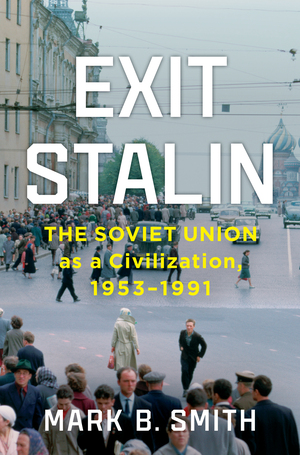
This is what Mark B. Smith documents in Exit Stalin: The Soviet Union as a Civilization, 1953–1991: not a structure of belief or its simulation, but the gradual displacement, over decades, of the question of belief itself. It is one thing to perform compliance while privately dissenting—a familiar instinct in the authoritarian and fascist regimes of the first half of the 20th century. It is another to have inhabited a system for so long that the distinction between compliance and conviction has simply ceased to organize experience. The second condition—the one Exit Stalin charts across nearly four decades—is the one that would outlast the Soviet state and travel, with consequences Smith’s book makes clear, into the world that followed.
What is lost when a political order is sustained not by conviction but by the slow routinization of participation?
The structural precondition for this was a distinction Smith draws carefully: The late Soviet Union was a dictatorship, but it was no longer a totalitarian state. Totalitarianism aspires to belief—it seeks the alignment of inner and outer life, the performance of conviction as a condition of survival. What emerged after Stalin and solidified under Brezhnev was a system that had largely abandoned the attempt to govern the interior lives of its citizens. The KGB still watched. Dissidents were still harassed, hospitalized, exiled. But for the vast majority of ordinary citizens, the regime’s primary demand had narrowed. It asked for outward compliance. It did not ask citizens to believe.
Such compliance is precisely what those eight lonely protestors defied in 1968. Remarkably, even decades later—as Soviet society remade itself alongside Gorbachev’s reforms—their protest would remain an outlier. The earlier normality had been a representation as much as a condition, and glasnost shattered both simultaneously. What the new era revealed was not a population waiting to be freed, but one that had lost the habit of imagining what freedom was for.
“The way we live is not normal,” people kept saying during perestroika. But what normality meant, nobody seemed to know.
On the morning of June 2, 1962, a young man walking the streets of Novocherkassk, an industrial city in southern Russia, heard what sounded like gunfire coming from the next block. His companion dismissed the thought: “Are you out of your mind? They don’t shoot people these days.” She was wrong. That day, troops opened fire on workers who had gathered outside the local party headquarters to protest wage cuts and rising meat prices. At least 24 people were killed.
What arrests the attention, over 60 years later, is not the violence, which was hardly new. More telling is the assumption—shared by workers and onlookers alike—that such things no longer happened. Almost a decade after Stalin’s death in 1953, ordinary Soviet citizens had genuinely internalized a new set of rules.
That this belief was wrong does not make it less significant. It tells us something essential about what kind of society the Soviet Union had become: one whose citizens had so thoroughly absorbed its rhythms that they could be genuinely shocked when those norms were violated. The engineer N. P. Bredikhin—a model worker whose photograph hung on the board of honor at the Novocherkassk Electric Locomotive Factory—threw Khrushchev’s portrait out the window when he heard the shooting. That gesture is Exit Stalin’s founding paradox: The Soviet Union’s normalization had been real enough to produce a man like Bredikhin, and not real enough to protect the people in the square.
Mark B. Smith, a historian at Cambridge University, has written a sweeping social history of Soviet life in the decades between Stalin’s death and the union’s collapse: a civilization, as his subtitle insists, not merely a system. The book is dense with character sketches and material texture: housing programs and abortion statistics, black-market favor networks and stadium poetry readings, the careers of scientists and the songs of guitar bards. His mode of presentation—accumulative, immersive, resolutely empirical—is itself a choice: to let the texture of Soviet civilization make the argument that no single theoretical frame could.
After Khrushchev’s Secret Speech in 1956—seven decades ago this year—the Soviet state offered not a revised ideology but a revised contract: You will not be arrested without cause; your pension will arrive; and your apartment will be yours. These were not liberal rights, but they were functional equivalents—real enough to change the character of the dictatorship. Twenty years after the Great Purge, the KGB’s preferred instrument was now what it called “prophylactic measures”: the intimidating interview, the signed statement acknowledging that one understood the limits, the warning delivered by someone in a good suit who drank your tea and left without incident. Seventy-five thousand Soviet citizens received such reminders between 1967 and 1974. Most of them went back to work the next day.
And the contract had another side. Under Khrushchev, over 100 million Soviet citizens moved into new apartments—their own front doors, their own tables around which family and friends could talk in something approaching privacy. The apartment was not a gift but a binding. To receive it was to become, quietly and permanently, someone with something to lose. And so people retreated inward not because the state drove them there but because, for the first time, inwardness had an address. Pensions were universalized, welfare extended, consumer goods began their slow diffusion. The writer Lyudmila Ulitskaya later recalled skipping the funeral of Boris Pasternak—the poet whose Nobel Prize the Soviet state had forced him to refuse—to take her German exam. The decision seemed entirely reasonable at the time. That it did is the point. A research scientist, interviewed decades later about the Brezhnev years, recalled knowing that at 40 he would receive a table clock from his institute, at 50 a crystal vase, at 60 a 20-rouble raise. The future was not bright, exactly, but it was legible.


And through the informal economy—the vast network of blat, personal connections and accumulated favors—that moved goods and services through the gaps in the planned system, one inhabited the institutions not despite their informalities but through them. Getting the right doctor, securing an apartment for a grown child, obtaining a scarce refrigerator: all of this moved through networks of mutual indebtedness, which were themselves a form of belonging. The boundary between compliance and corruption dissolved, because the system depended on both.
This is what institutional habituation looks like from the inside. It was a form of life so thoroughly calibrated to institutional rhythms that the question of whether one endorsed them had been displaced. When it was asked at all, it took forms the system could absorb without being threatened. The jokes are evidence of exactly this. “Is there life on the moon?” asks a student in a political literacy class. The instructor answers: “No, Comrade, Soviet cosmonauts have found no signs of life on the moon.” The student, sadly: “Not there either?” The joke circulated at workplaces and party meetings, in the very spaces the state had created. It was a shared, self-mocking skepticism that had found a form compatible with the system.
Soviet civilization even produced its own satirical masterpiece of institutional sameness: 200 million people watched a Soviet spy in a Nazi uniform in Seventeen Moments of Spring (1973), felt genuine pride in his achievements, understood the irony completely, and watched it again the following year. Dissent and participation had become, at the level of everyday culture, nearly indistinguishable—and nobody seemed to find that strange. That indistinguishability was not a failure of character—it was what four decades of institutional life produced. What did such a form of life cost?
Such a question matters well beyond the history of a vanished state. The political philosopher Judith Shklar offers a useful way of framing the problem. In The Faces of Injustice, she distinguishes between misfortune—bad things that happen to you—and injustice—being wronged by a system whose functioning you help to maintain. As Smith’s book notes, the union representative at the Kostroma Vodka Factory who accepted management’s decision to fire a disabled worker—after the worker had been transferred to a part of the plant he could not physically reach—was calculating the costs of resistance and finding them prohibitive. He was, in Shklar’s terms, simply a reasonable man. And yet his acquiescence made him a participant in the wrong. When the worker appealed and won and kept his job, that outcome required someone else to have done what the union rep would not.
The moral difficulty such situations produce is captured by Bernard Williams’s complementary insight: Genuine moral choices under constraint leave a residue, something lost that cannot be recovered by pointing to the rationality of the choice. The late Soviet citizen who signed a statement she did not believe in order to protect her apartment and her daughter’s university place was paying in a currency whose cost only becomes legible later, and in aggregate. Not innocence—that is too romantic—but something more precise: the habit of consulting oneself before signing.
This is precisely the condition Václav Havel described in 1978 from a neighboring Soviet bloc state. In The Power of the Powerless, he noted that every act of performative compliance reproduced the system in ways that its visible machinery of coercion could not. The greengrocer who displays the sign “Workers of the World, Unite!” was not expressing a belief: He was signaling his willingness to live within the lie. What the lie costs him is not comfort or safety—the system provides both—but the habit of his own judgment. The Czech or Polish citizen still had an outside—a pre-Soviet past, a national tradition, a neighboring West—against which Soviet normality could be measured and found wanting. The Soviet citizen, three or four generations in, had no such reference point and no prior order to mourn. The act of imagining alternatives had itself become unfamiliar.
It is one thing to perform compliance while privately dissenting. It is another to have inhabited a system for so long that the distinction between compliance and conviction has simply ceased to organize experience.
The cost of habituation was most legible precisely where it was refused. Institutional habituation was never complete. But the dissidents were not Westernized liberals who happened to hold Soviet passports. They were Soviet people whose critique was intelligible only from within: creatures of the Twentieth Party Congress, practitioners of what the Russian language distinguishes as sovest’—the inner voice that answers to no institution—from soznatel’nost’, the politically correct consciousness the Party demanded. The party could colonize soznatel’nost’. It could not fully colonize sovest’—partly because the Secret Speech had activated conscience from above, officially naming the crimes. This created a category of Soviet citizen whose habituation had been interrupted by the state’s own partial reckoning.
The bitterest evidence for what habituation had cost came not from the Soviet period itself but from its aftermath. When Gorbachev’s glasnost released the truth about Soviet history—the purges, the deportations, the Gulag—many citizens found it not liberating but unbearable. The cultural reckoning was visible on cinema screens: Vasili Pichul’s Little Vera (1988) opened with the national anthem playing from a kitchen radio while the camera panned across scuffed pans, dripping plates, an exhausted mother, salted fish—everyday squalor that Soviet normality had previously made unrepresentable.
And so, when the Soviet Union dissolved, people did not discover latent civic resources or suppressed political ambitions; they grabbed dachas and bought steel doors for their apartments. Within a decade, polls found that a majority of Russians regretted the Soviet Union’s passing. What they mourned was the stability of institutional habituation itself. The nostalgia was not for belief; it was for a world in which the question of belief no longer had to be asked.
Smith’s great achievement is to have written this civilization from the inside out—in the food queues and the bookshops, in the guitar songs and the blat networks, in the millions of new apartments with their own kitchen tables. He closes the book with an image: a young man in a shabby overcoat riding the escalator up from Moscow’s Pushkin Square metro on a December evening in 1975, running and skidding on ice toward friends at Pushkin’s statue, a young woman taking his hand. “Come on,” she says, “let’s all walk down the boulevard.”
The image asks the reader to hold in mind—without resolving—the warmth and contingency of Soviet civilization alongside its violence, its contradictions, and its end.
Vladimir Putin appears, in retrospect, as the most precise product of the culture Smith describes—and its most consequential reader. Putin put his party card in a drawer when it became irrelevant, as one might store a tool whose season had passed. What he grasped, and what Gorbachev never could, was that the informal architecture of Soviet civilization—the blat networks, the ambiguous property relations, the mutual indebtedness of millions of small accommodations—was the real system. Gorbachev destroyed the civilization (while trying to reform and save it) because he could not see that habituation and informality were the load-bearing structure of Soviet life. Putin understood—he had watched a generation learn how.
By the late Soviet period, millions of citizens had already mastered the arts of navigating institutions without believing in them: performing loyalty in public, relying on informal networks in private, converting access into advantage whenever the opportunity appeared. What Smith describes as the condition of ordinary citizens—performance without conviction, participation as an end in itself, and belonging sustained by the suppression of the question of belonging—Putin remade into a governing technology. He did not need his subjects to believe. He simply needed them to have forgotten, over decades, that the question of belief was one they were entitled to ask.


What is lost when a political order is sustained not by conviction but by the slow routinization of participation? The Soviet citizen who finally received his two-room apartment and settled around the kitchen table could plan a life; that plan was rational and it was completed on schedule. What it did not include was any vision of what the life was for. The doing went on, but the asking stopped. Exit Stalin’s deepest argument is that this is not a crisis—it is entirely sustainable. Until someone learns how to govern through it.
In his afterword, Smith asks whether the Soviet past caused the war in Ukraine or made it unlikely—and declines to answer. Institutional habituation is part of the answer: not a single cause, but the cultural precondition that made forgetting available as a governing technology—to whoever came next. 
- The term is not Smith’s, and it is not quite any of the alternatives the literature offers. Peter Sloterdijk’s “cynical reason” assumes a knowing subject who sees through ideology. Alexei Yurchak’s “hypernormalization,” the most influential account of late Soviet subjectivity, describes the process by which official language lost its meaning while remaining socially functional. Both locate the key variable in how individuals relate to ideology at a given moment. ↩