
Being reviewed:
Advertisement

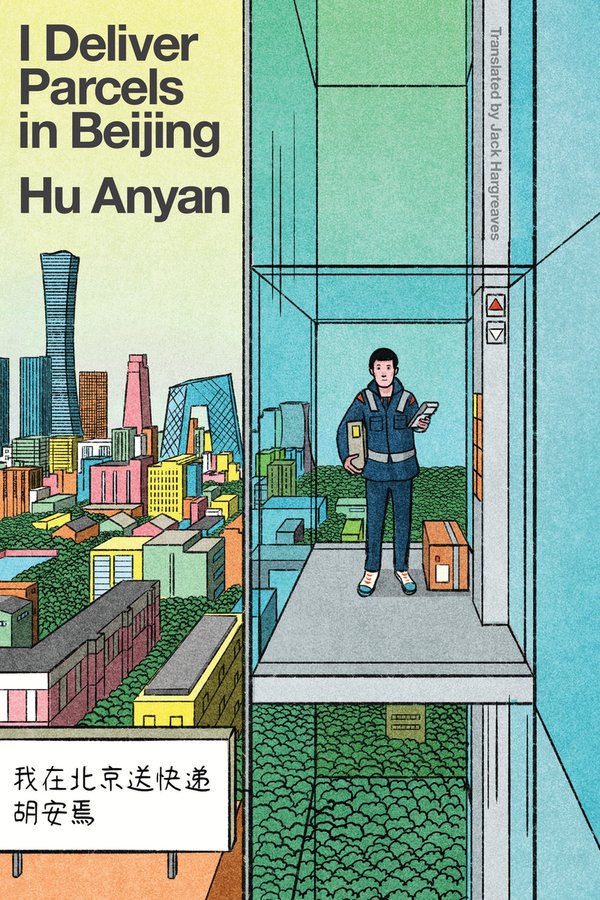
Reading about Hu Anyan’s litany of gig work in China—in his recently translated memoir, I Deliver Parcels in Beijing—is like watching someone go from resisting to accepting abuse in a personal relationship. At first, he keeps a “revenge list” of his most insulting customers. “I felt like a steel cable stretched to [the] breaking point and snapping,” he writes, though it is a fellow courier who finally loses it, smashing the hood and windshield of an Audi whose driver “had been beeping his horn at him from behind, nonstop, and driven him crazy.” Once Hu gives up his efficiency system, allowing the customers and the company to exploit him, he finds that “every customer was easy to get along with, and they all gave me genuine smiles.” Earlier in the book he suggests, “I don’t know if anyone really likes delivering parcels, deep down”; but by its end he attests, “When I handed over a parcel to a customer, I could see the satisfaction and excitement in their expression, and hear their pleasant thank-yous. I liked how that made me feel—useful…” In the book’s final words, “I have no lingering anger or resentment—I admit I once did, but I have let it all go. The more I have lived, the clearer it has become that a life filled with anger and hate is not one worth living.”
This sort of pillow embroidery may be true. But it does no justice to Hu’s and his coworkers’ specific mode of exploitation. It lets thuggish corporations and over-entitled customers get away with everything. Why?
One answer is that Hu’s book already passed through the hands of editors who cater to Chinese Communist Party (CCP) censors. The Financial Times reporter Edward White anonymously quoted some observers of the Chinese creative literary process, who likened it to “dancing in chains.” Writing for The New Republic, Rhoda Feng noted that I Deliver Parcels in Beijing was elevated as literature from “one inhabiting the di ceng (“bottom rung”) without being read as oppositional to or overly critical of the CCP.” Both writers note that Hu’s memoir fits with Xi Jinping’s goal of achieving “common prosperity,” or economic and social equality, by the mid-21st century. Feng suggests that the “quiet resistance” of Hu’s prose reflects his method of documenting abusive work conditions without collectivizing to argue or fight against them.
The atmosphere of constraint muffles louder expressions, such as a fellow worker’s suicide, which was removed from the book to please censors. Hu’s account of this unnamed worker jumping from his company’s office building in a logistics park appeared in an early draft and vanished from the published book. The reward for suppressing this story was that the People’s Daily, a CCP organ, hailed I Deliver Parcels in Beijing as “a must read.”
This failure to translate the exhausting experience of delivering parcels into meaningful critique is all the more disappointing because it comes from a creative artist and a writer. Despite its title’s focus on the logistics industry, Hu’s memoir chronicles nineteen different jobs, ranging from comic book artist, graphic designer, and writer to courier, convenience store clerk, bike store salesperson, e-commerce fashion retailer, and deli owner. Hu’s detailed accounts of these different gigs ground his reflections on the way work warps life at capitalism’s twilight. As the newest and bleakest example, delivering packages grabs the title. During an early, formative period in Beijing, Hu draws comics (his seventh job), designs graphics for a startup anime magazine (his eighth), absorbs Western rock and roll, and adopts a punk ethos. Though he grows into himself, he always seeks more security and takes fewer risks than his friends. In his downtime during a stint at an apparel shop in a mall, he reads American 20th-century realism: Hemingway, Salinger, Capote, Carver, Yates. He relates to their fiction because he sees China reaching the same levels of consumerism as the US: “people’s life experiences were being universally homogenized.” He practices writing and publishes a few stories in an online literary journal, turns to Joyce and Kafka, then abandons them to start writing short pieces on his phone.
This literary turn coincides with simplified politics and a concession to capitalist rapacity. On a trip to Binju, he encounters workers who had not received their wages but were nonetheless happy. Inspired to post on social media, he writes, “We are fortunate to live in the greatest era in human history, one in which our historical duty is not to struggle against scarcity, ignorance, and pointless suffering as our predecessors did. Our duty is to boldly embrace happiness.” The propagandistic tone couldn’t be clearer.


The outrageous expectations placed on Chinese e-commerce couriers may surprise Western readers. When customers mistakenly enter old addresses and packages are misdelivered with no hope of retrieval, Hu must pay for them from his paltry wages. When a thief steals a heavy box of kindergarten books from the top of Hu’s delivery tricycle, he must shell out almost a thousand yuan to replace them. Selfish customers make absurd demands. In the most galling example, Hu unexpectedly finds a customer away from home, so he thoughtfully leaves her package of cut durian in her apartment complex’s shaded locker, where it has a better chance of staying fresh in the summer heat. Two hours later when he is across town, she finally calls him back, demanding that he return to the neighborhood and bring the fruit to her door rather than walk downstairs to collect it herself.
Such interactions document consumers’ obliviousness to labor along the supply chain. Though they illustrate how apps have deteriorated social relations, Hu simply views his customers as selfish and greedy, typically ready to screw him over to save a few yuan.
Yet the worst offenders are the delivery companies, with their stingy wages and obtuse management. Hu calculates that to live frugally in Beijing, he must make 270 yuan a day for twenty-six days a month. At eleven hours per day, two spent loading his trike and driving, and an average of two yuan per completed delivery, he must deliver a parcel every four minutes.
[If] a minute was worth .5 yuan, then the cost of urination was 1 yuan—that is, if the toilet was free to use and I only took two minutes. Eating lunch needed twenty minutes—ten of which were spent waiting for the food—and had a time cost of 10 yuan. If a simple dish of rice and meat cost 15 yuan on top of this, then the whole endeavour was too extravagant! Basically, I skipped a lot of lunches.
His simple math discloses the cost of a human life’s time span. “I’m avoiding calling it ‘my price,’” he notes, as minutes, hours, days, weeks, and months are converted into others’ forgotten purchases. Hu’s autobiography concretizes our intuitive sense that behind every dazzlingly fast delivery time lies a hungry, exhausted worker.
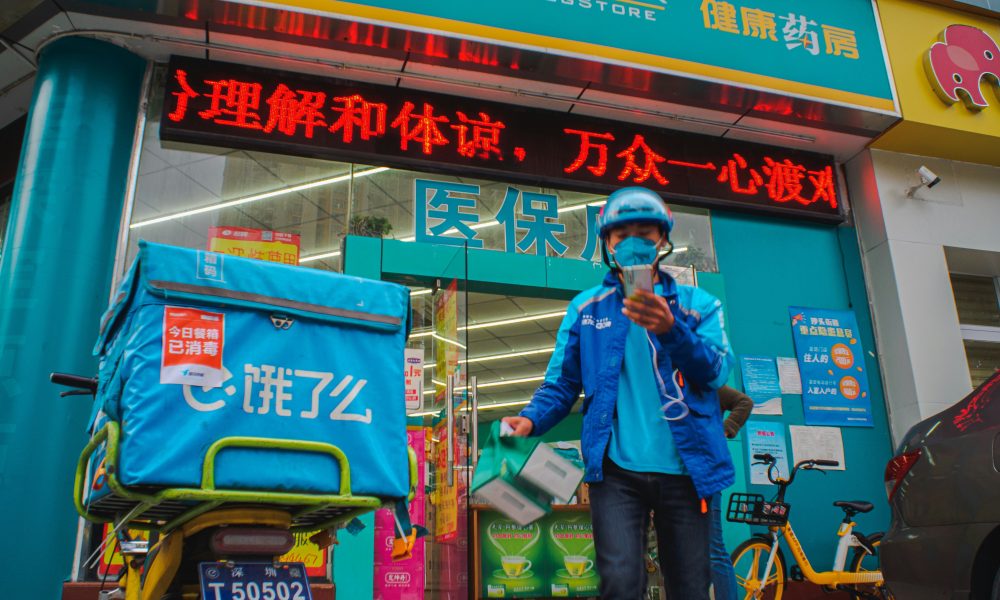
Hu delivered packages in the late 2010s, just when the “ultrafast” or “q-commerce” economy was taking hold in China and India. In “quick commerce,” couriers deliver goods on e-bikes in as little as ten minutes. The practice reset expectations for cheap, convenient pleasures, such as a one yuan bubble tea handed to you almost immediately. By 2025, this race to the bottom—cheaper prices, lower wages, speedier deliveries—caused the Chinese ultrafast sector to start collapsing. With such deep discounts and high operating costs, big platforms such as Alibaba, Meituan, and JD.com watched their profits erode. In the US, though Amazon and Walmart compete to reduce delivery times, they are unlikely to build out the numerous unattended “dark stores” to hold high inventory and instantly gratify customers. And after the Trump administration’s terrorist campaign against immigrants in major cities, the workforce for such labor has likely vanished into detention or hiding.
Nonetheless, ultrafast delivery has exerted pressure on the entire sector, bringing ordinary delivery times down to the same day and within two to three hours. In time, Hu’s narrative may stand as a historical document of peak convenience, an entire industry based on fulfilling infantile wishes.
Such experiences of menial work should be artfully documented. Not to buy us a life of freedom and wealth, but to move all of us closer to meaningful collective action while we still have the chance.
In the Anglophone press, a critical divide over Hu’s voice reflects the ambivalence of this “quiet resistance.” The Guardian’s Joe Moran disliked the “deadpan, faux-naif” texture of the book’s “flat, one-note prose.” Washington Post reviewer Becca Rothfeld found Hu’s frequently stalled, circling, or meandering storytelling at best hypnotic and at worst, “boring.” The Economist’s unsigned review observed that some Chinese critics dismissed I Deliver Parcels in Beijing as “liushuizhang—a ‘running account’ that reads like an artless retelling of daily life.” Arguing the contrary in Wired, Xiaowei R. Wang rhapsodizes that “Hu’s minimal, hypnotic prose reveals the perverse beauty of tireless endurance in an increasingly precarious economy.” Keen to sell books, Publishers Weekly praises Hu’s “blunt, unvarnished voice, skillfully rendered by Hargreaves.” Similarly, Kirkus Reviews claims of Hu’s book that “its star is his voice” and praises its “distinctive deadpan soul,” a phrase so nonsensical that I at first suspected it was an AI hallucination.
Yet the phrase may make more sense to those Chinese readers who regard Hu’s sedate descriptions of gig economy ennui as risky and bold. White has identified Hu as part of “a new wave of yesheng zuojia, or wild writers,” aloof from the literary establishment; he has also been claimed by literary movements of the proletariat (pu luo), migrant workers (da gong), and leftists (zuo yi). As Megan Walsh notes in UnHerd, fellow da gong writers such as Xu Lizhi and Fan Yusu are sounding the “discordant messaging” of contemporary China, a socialist country in which hundreds of millions of workers are cruelly exploited. “Deadpan soul” might express this cognitive dissonance.
I think the book’s blandness also results from its origins in online platform writing. The editor Pu Zhao discovered Hu’s essay “My Year of Night Shifts in a Logistics Warehouse” posted on Douban, a Chinese literary site similar to Goodreads, but with a section where writers can upload original material. Admiring Hu’s bloodless style, Pu offered him a book contract. In an interview with Lai Fei in Art Review, Hu described similar posts to the more avant-garde site Heilan, which were also published in book form: “You don’t need to devise a storyline, you just have to think back and recall as many details as possible. Not much technique is required.” In keeping with his mastery of logistics, this is a workmanlike, efficient method. “I find it easier and faster to write nonfiction, sometimes a few thousand words in a day, while fiction might take much longer, even just a few hundred words a day,” Hu attests. “I was not totally sincere and just trying to get the job done.”
This industrial style of production resulted in the odd structure of I Deliver Parcels in Beijing, which swerves from delivery to Hu’s other jobs “because the publisher felt the book was too short. That addition wasn’t entirely heartfelt for me. I didn’t feel a strong connection to the materials I was excavating.” Whether in logistics or literature, Hu conceptualizes his activity as quantifiable output; as a writer, he operates like a recording device.
This practice reflects the ethos of online writing: We tell the world what happened to us, as quickly as possible; readers consume it just as fast. There is no time to make a reflective work of art. If logistics could talk, it might sound like Hu’s voice.
Now, however, Hu has plentiful time to explore the art of writing. The success of I Deliver Parcels in Beijing, as well as earlier memoirs, has catapulted him into a bourgeois paradise of full-time writing. Will anyone care about what more he may have to communicate?
Quite possibly. Drab, mild literature-as-accounting may perfectly suit the “lying flat” attitude of younger Chinese generations. Similar to “quiet quitting,” “lying flat” (tang ping) rejects overwork and overachievement, embracing its correspondingly reduced lifestyle of simpler desires. It represents a middle ground between corporate, right-wing striving to seize as much of the world as possible before it floods or explodes, and progressive efforts to fight for democracy and collective resource management. Like I Deliver Parcels in Beijing, “lying flat” does not connect creative expression to progressive politics.
Can it be called a movement if it involves neither motion nor energy? At the same time, one can hardly blame Hu and his fellow da gong writers for not directly challenging the Chinese regime, which is well-known for imprisoning its critics.
Western memoirs and novels about low-paid work convey more outrage with more nuance. Heike Geissler’s Seasonal Associate, recounting her time in an Amazon warehouse, is acerbic even when describing her defeated exhaustion. Peter Mendelsund’s elliptical, Kafkaesque The Delivery, follows an unnamed immigrant Delivery Boy in an unnamed foreign city, replicating the experience of learning a new language. John Tottenham’s Service, told by a curmudgeonly bookstore clerk-cum-writer who is drowning in debt, mounts a hilarious critique of the political economy of literature. Such experiences of menial work should be artfully documented. Not to buy us a life of freedom and wealth, but to move all of us closer to meaningful collective action while we still have the chance.