Being reviewed:
Advertisement

It’s hard to talk about suicide; it’s even harder to understand it.
The word “suicide” describes an act in the present. But in truth, the temporality of suicide is largely anticipatory or retrospective. It is the untiring fear that a loved one will hurt themselves; it is the relentless ruminating on why they have chosen to do so. Unlike death, suicide is a choice. This distinguishing characteristic causes a world of difference; it implies a logic. And yet the paradox of suicide is that this logic is opaque—and the person who could explain it is gone. All that remains is groping around for clues. A suicide note, in the best of cases. A retracing of steps, in the worst.
From this vacuum of understanding, writing emerges. If it is hard to talk about suicide, perhaps it is easier to write and read about it. An exchange of grief, fear, and curiosity about the ultimate act, safely contained within the intimate relay between reader and text.
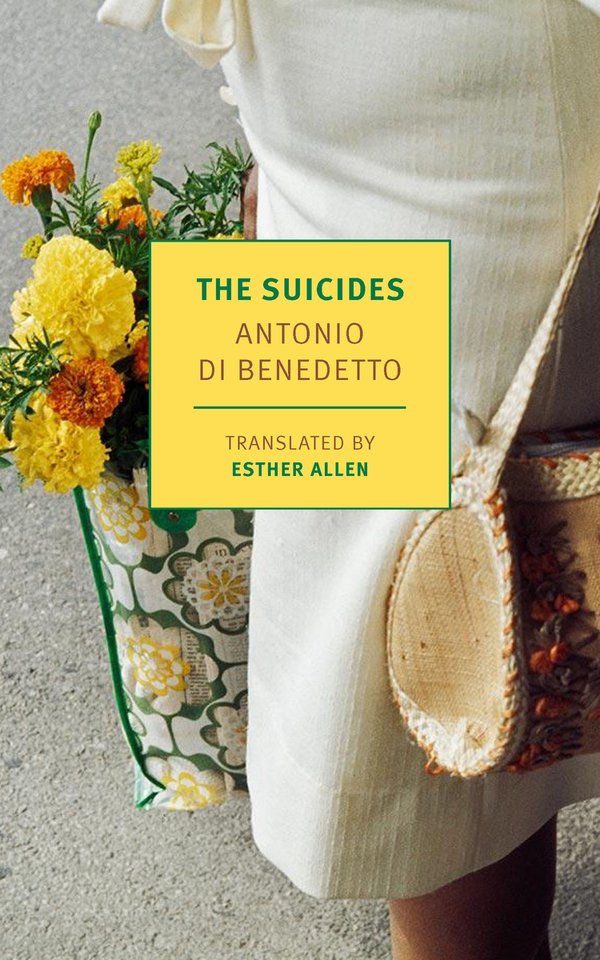
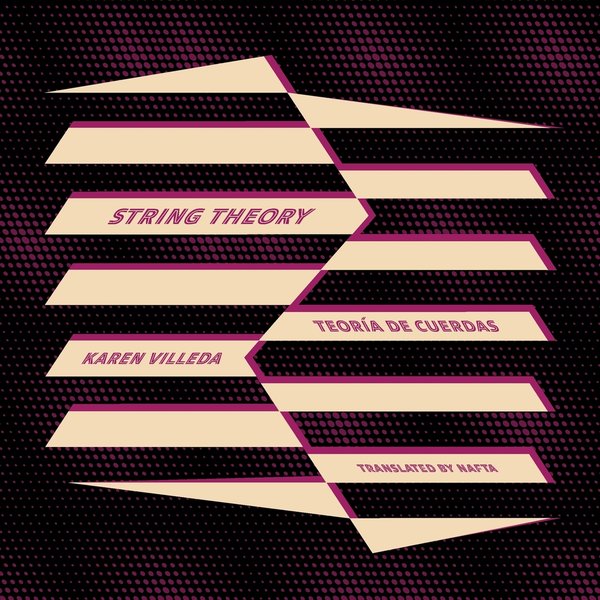
Two Latin American books recently translated into English explore the difficult subject of suicide through markedly distinct forms and styles. Argentine novelist Antonio di Benedetto’s The Suicides, originally published in 1969, has been expertly translated into English by Esther Allen and published by NYRB Classics. Karen Villeda’s autobiographical poetry collection, String Theory / Teoría de Cuerdas, is available as a bilingual edition through Carboard House Press, translated by NAFTA, a collaborative trio including Whitney Celeste DeVos, Zane Koss, and Gerónimo Sarmiento Cruz, who go by the cheeky name The North American Free Translation Agreement / No America Fraught Translation Argument, an acronym that alludes ironically to the 1994 North American Free Trade Agreement.
At first glance, The Suicides and String Theory make an odd pairing, representing different forms (fiction and autobiographical poetry); time periods (Argentina in late 1960s and Mexico in the early 2020s); tones (sardonic and earnest); and perspectives (male and female, albeit both in their 30s). The Suicides’s middling, petulant protagonist, through which di Benedetto diagnoses male mediocrity and privilege, contrasts sharply with Villeda’s reflexive introspection and acute awareness of gendered violence. But both books are fundamentally preoccupied with how the suicides of others informs the self.
Both narrators are shaped by suicide. The Suicides opens by recounting that the narrator’s father killed himself at the age of 33; the same age the narrator will turn next month. The narrative voice of String Theory explains that she was named after her aunt, Karen, who took her own life just two months after the narrator was born. The texts that unspool in suicide’s wake aim to make sense of these absences that are nonetheless so present: a string that binds family history, for Villeda, or a possible scoop that becomes an obsession, in The Suicides.
In each case, suicide is an end through which to process a senseless present. Alternately a morbid spectacle, a philosophical quandary, and abyssal grief, in both books, thinking about suicide is not only to grapple with someone else’s decision to die, but also inevitably with one’s own decision to go on living. It triggers a search for the right words to unlock what motivates self-harm and self-sustenance in a context of generalized violence.


The Suicides is the third novel in di Benedetto’s Trilogy of Expectation, all of which are finally available to readers in English thanks to Allen’s efforts, buttressed by support from the Guggenheim Foundation. My personal favorite is Zama, about a frustrated colonial functionary in 18th-century Paraguay. Lucrecia Martel adapted Zama into an equally spectacular film, where what matters is not so much what is in frame, but what can only be glimpsed or heard.
While di Benedetto did not come up with the idea of the Trilogy of Expectation—it was imposed on his work posthumously—the name is apt. “La trilogía de espera” can be translated as either the trilogy of expectation or of waiting. This is the elemental state of his protagonists, who are all stuck in a state of suspension, whether they realize it or not.
The protagonist of The Suicides spins his wheels. A journalist fascinated by suicide—and anticipating his upcoming 33rd birthday, the age his father was when he died—he decides to report on local cases of fatal self-harm. The police refuse to release details about suicides to the public, for fear of inspiring copycats. The taboo simply enhances its appeal; di Benedetto’s protagonist is confident that readers will clamor for more. But throughout the novel, he dithers and postpones: “I’ll work tomorrow,” “we’ll spring into action the day after tomorrow.” It’s his female colleagues—an archivist, photographer, and lab technician—who advance his investigative work, procuring the relevant case files, statistics, and philosophical takes, which the protagonist blithely assimilates as his own.
And yet, despite this outsourced help, he makes no progress. He never writes up his reporting, never turns anything in. His self-serious philosophical musings on life and death are narratively undercut by his womanizing and his breezy, uninformed opining: “in point of fact I don’t know who Durkheim is. An authority on the subject perhaps. The Louis Pasteur, the Marie Curie of suicide. Who knows.”
Even in his personal life, every year he promises to take his mother on a vacation, a plan that is perpetually deferred. This stasis and inaction culminate in the novel’s final pages, when he backs out of a suicide pact, vaguely promising to report on it instead. The punchline—albeit perhaps in poor taste—is that the indecisive protagonist, who can’t make good on anything, would naturally put this too off for some later date.
Di Benedetto’s novel is not a serious account of suicide, or of the grief left in its wake. It is oriented elsewhere: a sardonic take-down of society’s lurid fascination with suicide and of the men who fixate on it—rather than on the mundane business of living ethically day in and day out—as the key existential question. Like the other novels in di Bendetto’s trilogy, The Suicides is a keen study of masculinity.
Led by a narrator who has no trouble agreeing with a female colleague who deems him “quite an unpleasant individual,” it is preoccupied with what we might anachronistically call toxic masculinity. In one of the suicide cases the narrator investigates, a father whose son has taken his own life is fixated on rebuffing the notion that there was fear in his son’s eyes: “Fear? My son? No, no señor. There was nothing in his eyes. My word as a gentleman: I saw nothing, nothing.” Elsewhere, a member of a volunteer fire brigade commits arson to “enable the volunteer fire brigade to demonstrate its courage and skill.” The narrator endorses this ludicrous act, explaining that to be a man with nothing to do is terribly, terribly painful. Through instances like these, di Benedetto slyly comments on the allure of authoritarianism for wayward men: its promise to restore masculine valor by triggering crises that only they then can help solve.
“I, too, am oppressed by what I don’t do” is a statement that sums up the absurd core of The Suicides. Men who see themselves as victims of a society that doesn’t need them, who then enact harm so as to be of use; men who oppress others because otherwise they feel oppressed by their own inaction. Di Benedetto’s theory of toxic masculinity remains all too relevant today.
Although the first-person narration of The Suicides allows for little social context to infiltrate the narrator’s self-centered worldview, the zeitgeist is of a piece with the era: the late ’60s, during the Argentine revolution, a dictatorship that ran from 1966 until 1973. A prelude to the Dirty War, this dictatorship aimed to establish a Catholic, corporatist authoritarian state. It put a stop to democratic elections and sought to eradicate leftist ideology by repressing students and professors. None of this context is made explicit, but the way the protagonist tries to protect himself by not thinking about his father’s suicide parallels the way in which he is oblivious to state violence.
It is important to note that, in 1976, a few years after publishing this work, di Benedetto was jailed and tortured for over a year during the Dirty War, perhaps for his work as a novelist or perhaps for his work as a journalist at the newspaper Los Andes—the reason was never made clear by his captors. Read in this context, the narrator’s death drive can be understood as a logical manifestation of the helplessness that many feel in times of rising fascism. It is something one can do. After remarking that he’d like to kill the “cruel swine who make the world an ugly place,” the narrator concludes that since he can’t get rid of them all, “if I do away with myself, they’ll no longer exist for me.” Di Benedetto pessimistically assesses self-harm as the only form of agency that remains in the context of fascism.
One of the paradoxes of suicide is that the decision to opt out of the future makes the future.
The narrator of The Suicides confesses at one point that he pushes his father’s suicide from his mind as a self-protective measure. This is far from foolproof. The narrator’s denial leaks into everything else; his father’s legacy is palpable and omnipresent throughout. Karen Villeda’s String Theory / Teoría de cuerdas is also interested in how suicide profoundly shapes the self.
The collection’s title refers to a proposal in theoretical physics that the universe is made up of vibrating, one-dimensional strings, rather than discreet points. String theory is a “theory of everything”: a framework that unites the seemingly irreconcilable approaches of quantum mechanics and general relativity. The string theory put forth by Villeda is also a theory of everything. Her aunt Karen “is a never ending string” that binds everything and everyone—most notably, Villeda and her aunt, and her aunt with the rope that she used to end her life. Villeda uses language to further blur these lines. Rope, in Spanish, is feminine: cuerda. Whereas in English the pronoun for rope is “it,” in Spanish, it is “ella” (she). Villeda uses “ella” such that it could refer to the rope or to Karen, leading us to ask whether her final act has become irrevocably sutured to her self. This linguistic play is impossible to reproduce in English, which NAFTA mentions in their translator’s note. They must choose a side, which facilitates the readability of Villeda’s characteristically challenging abstraction, but loses the upshot of undifferentiation. Luckily, Cardboard House’s bilingual format allows the reader to toggle between both versions.
Reading String Theory is like gaining access to the perspectives of the competent women who are silenced and sidelined by the egocentric narrator of The Suicides. Aunt Karen is an absent presence in the poet’s family, rarely spoken of, rarely named. Or rather, she is constantly named, but the name “Karen” no longer refers to her, but to the poet. Through propulsive prose poetry that moves forward in abstract bursts, fragments of dialogue, and even lists, String Theory maps this unfolding of Karen as other and Karen as self, Karen as someone who is dead and as someone who is not.
The ontological blurring of Karen with other things (the rope, the string) extends to the poet herself. When Villeda Googles her aunt, the search result is about herself. Sharing a name is unsettling; a tie to another version of herself who has chosen to die. The poetic voice explains: “I grew up with her name. / They call me and my retina detaches / because she is hanging from me. / She is one of whom I could have been.” “We supposedly share the same name. I wouldn’t want her name to sound like mine.”
Part of the power of String Theory resides in its willingness to articulate the contradictory emotions that crop up around suicide. Karen cannot free herself of Karen. It is a weight that takes on more gravity as the poet struggles with depression herself. And yet there is a persistent call to speak about or for her deceased aunt that erupts into first person: “Don’t shelter me in your memory: I need to exist. Don’t shelter me in your memory: I need to be there.” String Theory is that existence of Karen’s voice—not a refuge, not a private remembrance—as something that circulates out there.
String Theory registers Villeda’s attempt to talk with others about her aunt’s suicide. Numerous poems present decontextualized dialogue from conversations with family members, forming a chorus of contradictions. Some sympathize with Karen’s act; others contend she must have regretted it. Particularly unnerving is the lack of consensus on whether Karen took her own life or if she was murdered in an act of femicide. This uncertainty injects turbulence into String Theory: Did Karen chose to die, or was she killed?
It also places String Theory in implicit conversation with other literary works in contemporary Mexico that discuss pervasive violence against women, like Cristina Rivera Garza’s memoir, Liliana’s Invincible Summer (2023). Of a piece with the 8-M feminist movement that frames mourning in the context of impunity as a refusal to turn away from the pain of the past, String Theory asserts that the dead demand attention. “She who commits suicide persists in the here and now”; “this is the language of suicides. Their atemporality. The verticality of sorrow.”
One of the paradoxes of suicide is that the decision to opt out of the future makes the future. It is not confined to a specific moment in time, as the act implies. Rather, in its wake, loved ones are left groping in the dark. Searching for a way to narrate the decision to leave the world behind, awash in “the verticality of sorrow.”
Antonio di Benedetto’s novel The Suicides and Karen Villeda’s autobiographical poetry collection String Theory are both oriented around suicide’s enigmatic pull as taboo, spectacle, and wound. By reading these markedly different texts together, we get a sense of how suicide compels a forensic quest for understanding violence that is enacted both against the self and against others. A forensic quest that in turn compels writing. 
This article was commissioned by Bécquer Seguín.